In this article
The cat that beckons
Maneki-neko means “beckoning cat”. The traditional figure raises a paw and often carries a coin, bib or other symbols of prosperity. It belongs to a Japanese culture of good wishes, familiar from shop and restaurant entrances.
SFO Museum connects the spread of these figures with the late Edo period and ceramic workshops. Their appearance varied with their place of manufacture: faces, proportions, bib designs and materials differed. Maneki-neko has long existed in many interpretations.
A collectible object can be appreciated for that history as well as its design. Giving one as a good wish for a new home or another person is an understandable gesture. Its symbolic meaning remains a tradition, rather than a promise of financial results from a figure.
Several stories of origin
There is no single undisputed account of the cat’s beginning. Japan’s cultural centre in Singapore retells the legends of Imado and Gotokuji Temple. In one, ceramic cats help a poor woman; in another, a cat beckons a traveller to shelter and saves him from a storm.
These stories give the image an emotional background: a small creature brings help or a fortunate meeting. They are worth knowing even when the object is chosen primarily for its appearance, with the understanding that they are legends.
An official cultural account of Tokoname places the figure’s wider emergence around the middle of the nineteenth century. Local production developed later. That distinction between a shared motif and a particular maker is useful for BE@RBRICK too: the beckoning cat’s history extends beyond any one series.
How a cat became a bear
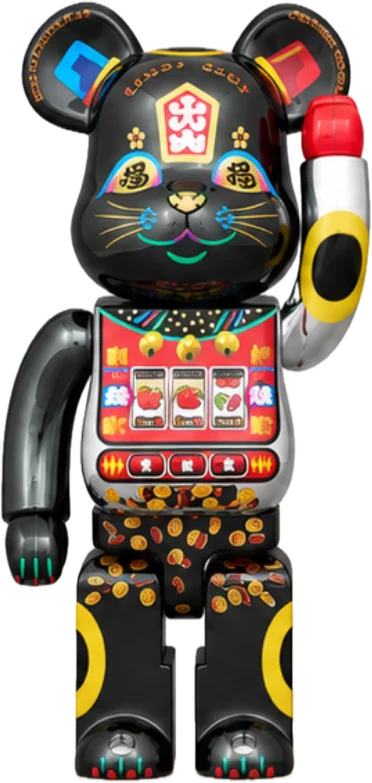
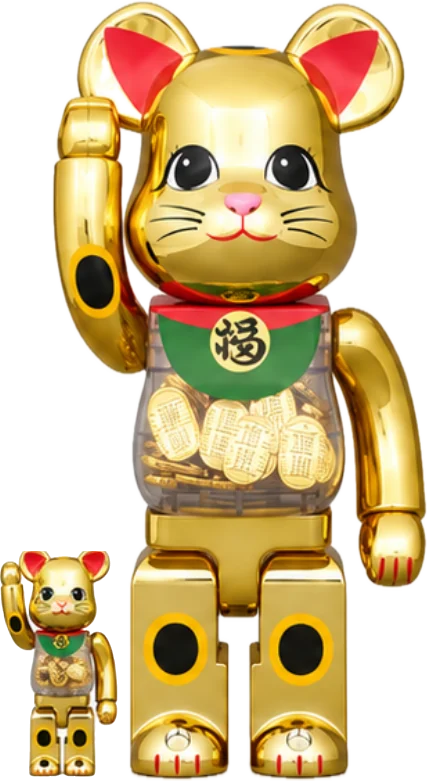
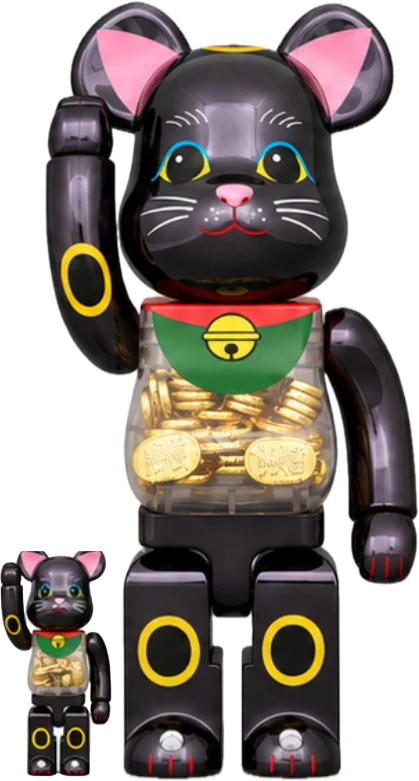
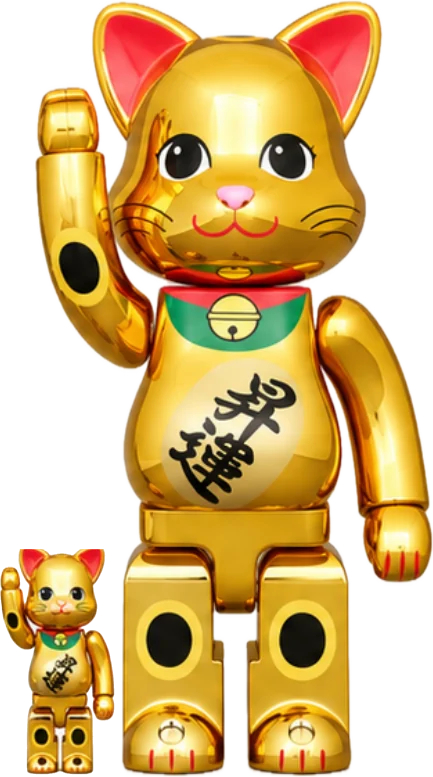
MEDICOM TOY retains BE@RBRICK’s characteristic proportions: a round head with ears and articulated arms and legs. The face, whiskers, markings, coin and lettering establish its feline identity. The cat remains recognisable while the bear shape stays present.
This makes the series an engaging neighbour for other art toys. It brings a cultural source and its own graphics into a shared format. Beside an artist’s design or a film character, it shows how one platform can connect quite different subjects.
A close view of the face is particularly useful. Eye placement, mouth expression and patches can change its mood more than an overall photograph suggests. One cat feels ceremonial, another playful, while another draws attention through its elaborate surface.
MEDICOM TOY also makes the separate cat-shaped NY@BRICK platform, with its own silhouette, sharper ears and different sizes. Explore NY@BRICK Lucky Luck Gold in our catalogue. The Maneki-neko motif spans different forms, so the platform name deserves a separate check.
Solamachi: an important address
MEDICOM TOY TOKYO SKYTREE TOWN Solamachi regularly appears in official Maneki-neko announcements. The Tokyo shop forms part of particular release histories, without necessarily describing every BE@RBRICK with a cat’s face.
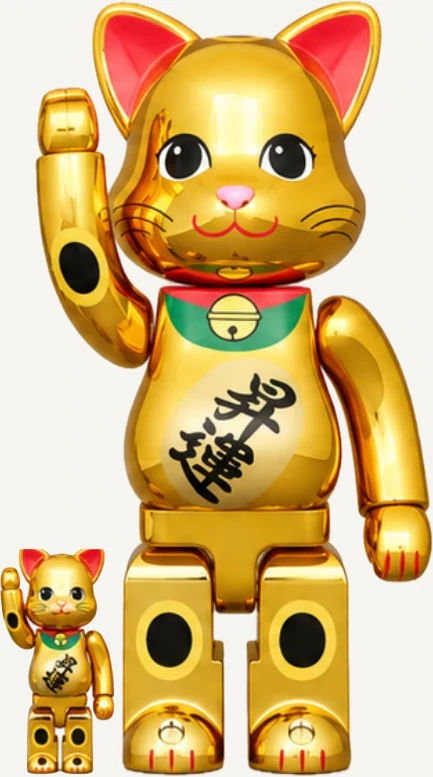
Gold Plated 6, for example, was announced for sale on 17 January 2019 in 100% and 400% formats. The shop entry also identifies a calico pattern. Six is part of the version name, rather than a statement that only six examples were made.
Such details make release names easier to read. A version number, size and sale date each communicate something different. Keeping them with a photograph makes a particular cat easier to distinguish from a similar gold-coloured release later.
The character of a gold-coloured surface
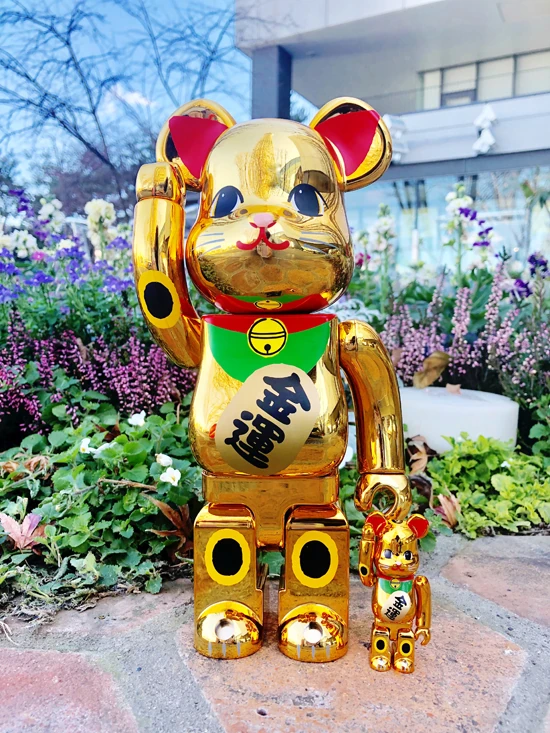
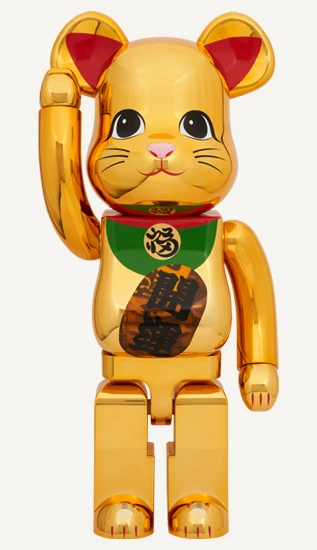
Gold-coloured Maneki-neko is one of the motif’s most familiar interpretations. Gold carries associations with wealth in traditional symbolism; in a room, it works through colour and reflection. A bright window, dark furniture and surrounding objects can transform its appearance.
金メッキ identifies a gold-plated finish in the release name. It does not establish a body made entirely from gold. The exact decoration matters: face graphics, accents, lettering and the completeness of the object all contribute to its identity.
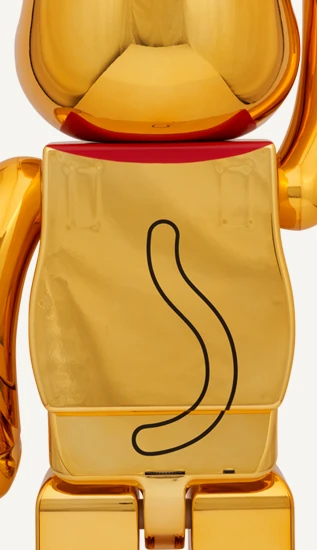
Side photographs help reveal how the finish reads across the form and whether there is visible damage. At home, a warm tone elsewhere can support it, or the cat can stand alone as a reflective accent. Its surroundings become part of the surface you see.
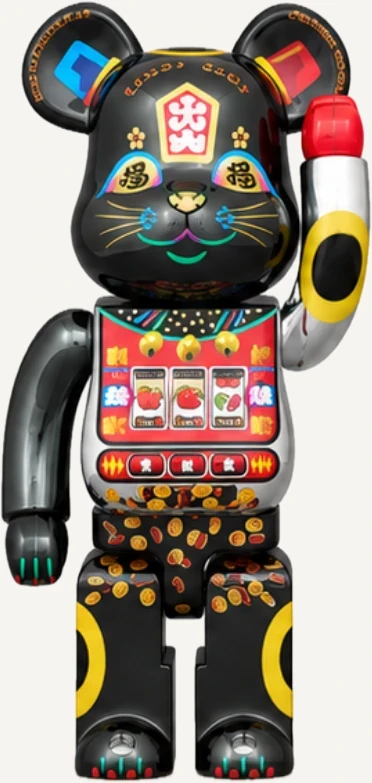
Our Maneki-neko Lucky Cat Jackpot 400% shows another approach to colour and ornament.
Kaiun 1000% with illumination
The Maneki-neko Kaiun Gold Plated Light 1000%, announced for January 2024, officially includes a lighting unit inside its body. This version is approximately seventy centimetres tall. It offers another way of displaying the motif, with an appearance that changes through more than external light.
It is useful to see both illuminated and unlit views before choosing. A striking evening effect can become quieter by day. A larger object also benefits from planning its position and access to any controls in accordance with its instructions.
“Glowing” can describe different effects. An internal lighting unit and a luminescent coating work differently. Each release’s description establishes which effect belongs to the particular figure, even when both look dramatic in dark photographs.
Kaiun Light 1000%
A pink costume and a different mood
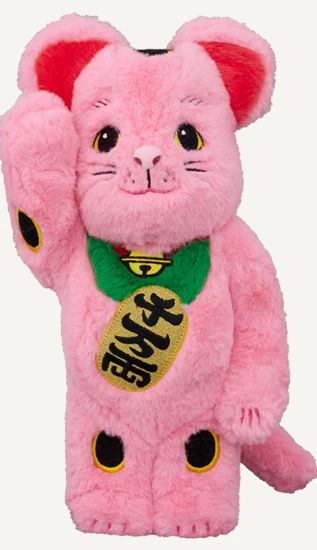
Maneki-neko Costume Pink 400% was announced for November 2024 at approximately twenty-eight centimetres tall. The official name uses 着ぐるみ, referring to a character costume. The idea approaches the familiar form in another way.
This version may appeal when a gentler mood suits the room. Pink shifts the associations and allows a group of cats to differ through more than their shine. One motif can appear festive, calm or deliberately playful.
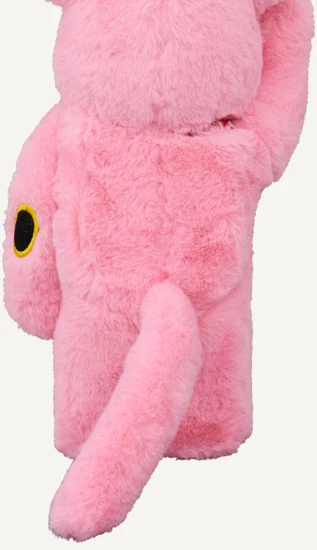
Photographs of the exact model remain the best starting point. The word “pink” alone says little about texture or construction. Overall views, facial details and the figure’s relationship with nearby objects help explain what the version offers.
Costume Pink
Karimoku: a cat made from wood
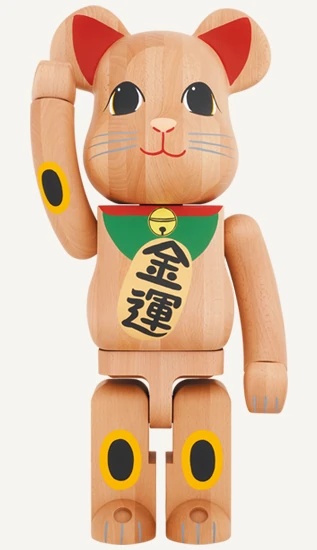
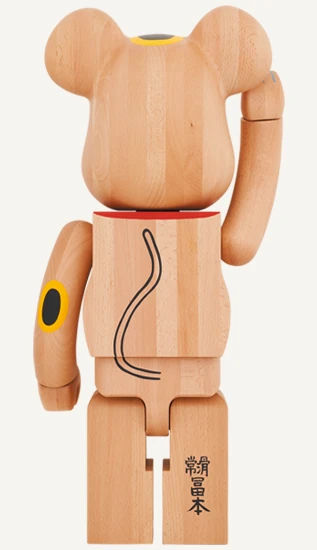
Karimoku Maneki-neko II 1000%, announced for April 2022, is officially described as wooden and approximately seventy centimetres tall. Its description names a collaboration between Karimoku and Tokoname beckoning-cat artisan Tomimoto.
Wood connects the familiar silhouette with furniture craftsmanship and natural texture. Beside a reflective gold-coloured surface, it invites another kind of attention: grain, the transitions of the form and decorative details become part of the experience.
Material can provide a collecting direction as effectively as colour. A wooden cat and a gold-coloured cat reveal different aspects of one motif. A large figure needs a stable position, clear space around it and room to be appreciated without tightly packed neighbours.
Karimoku Maneki-neko II
BAPE: the cat and daruma together
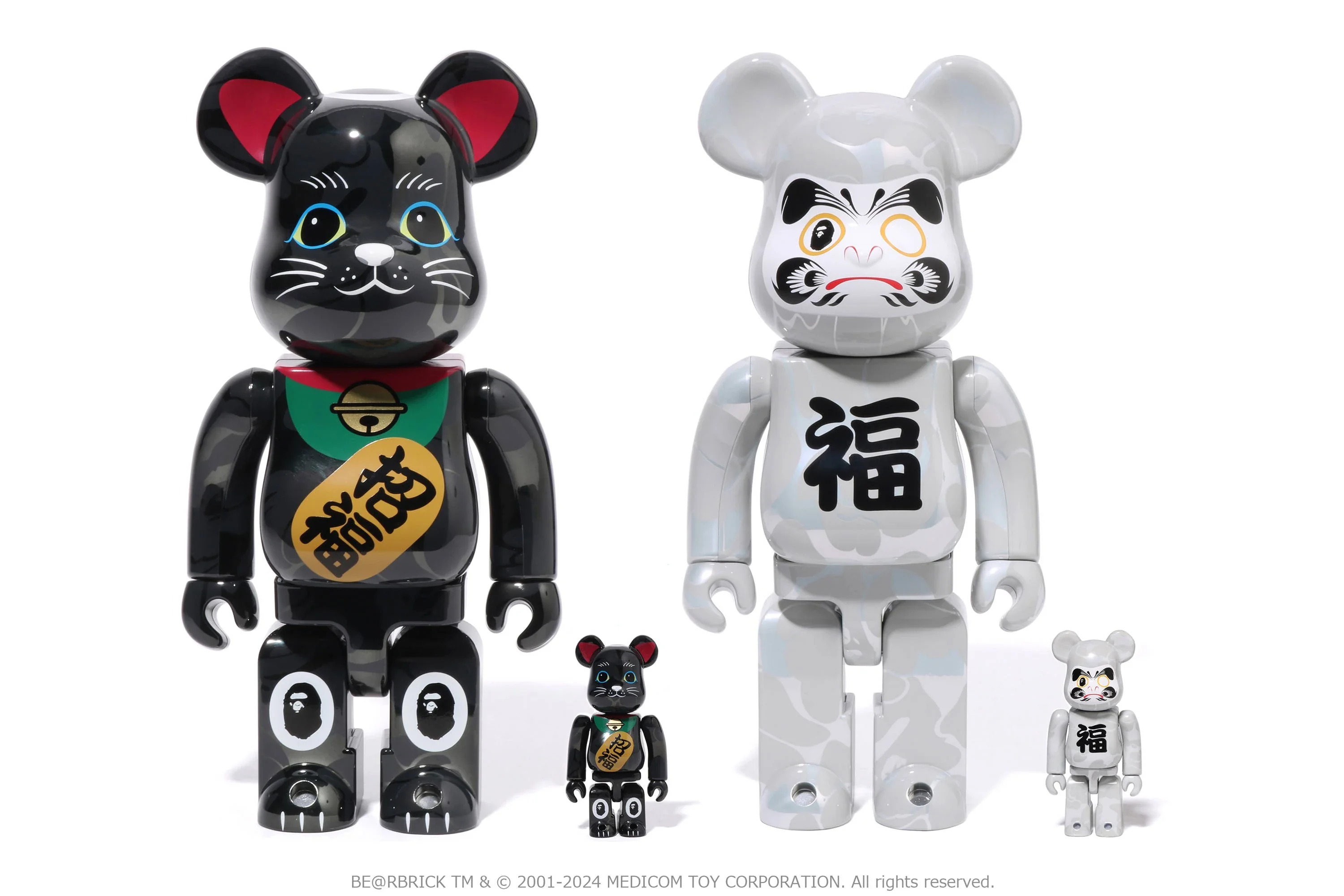
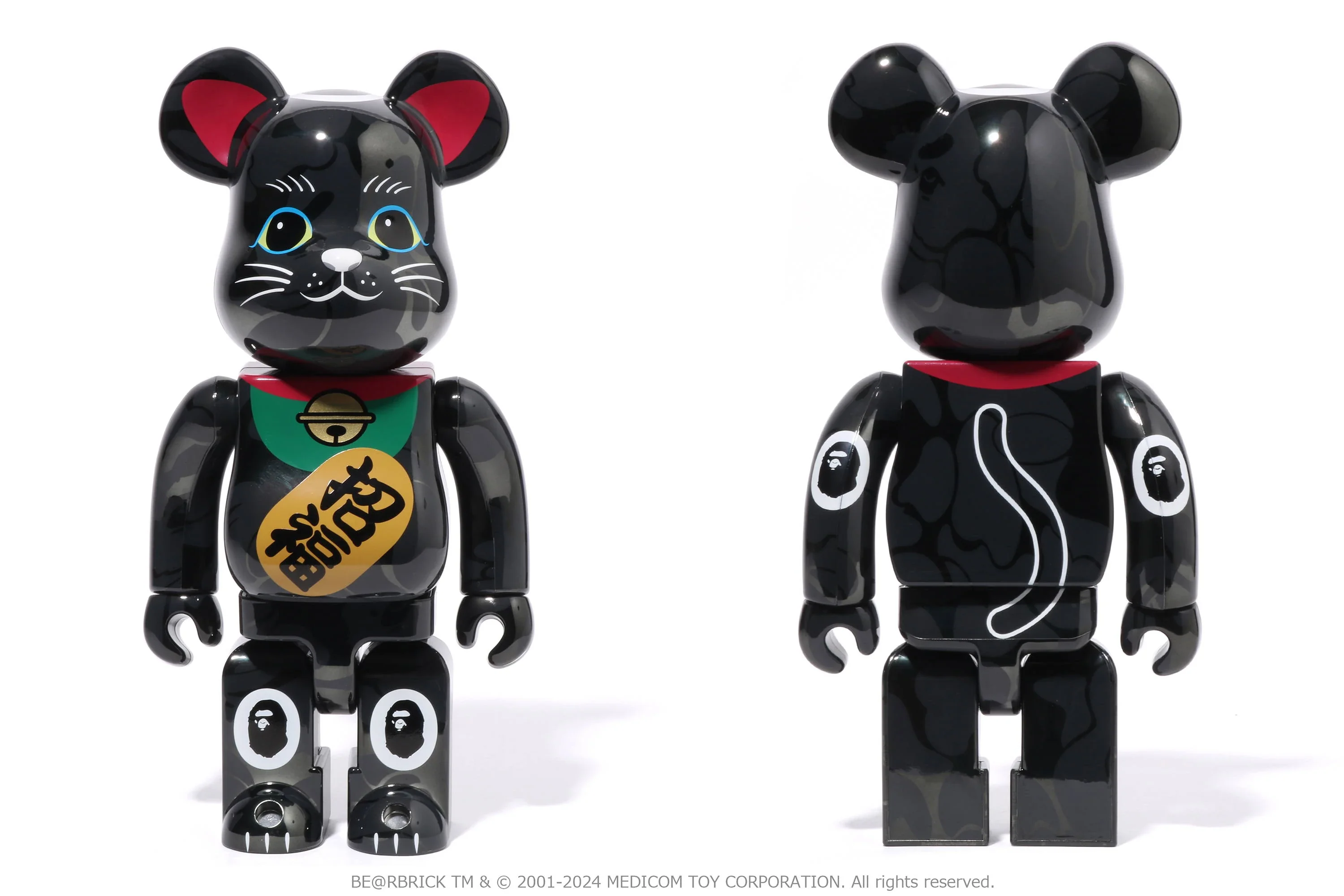
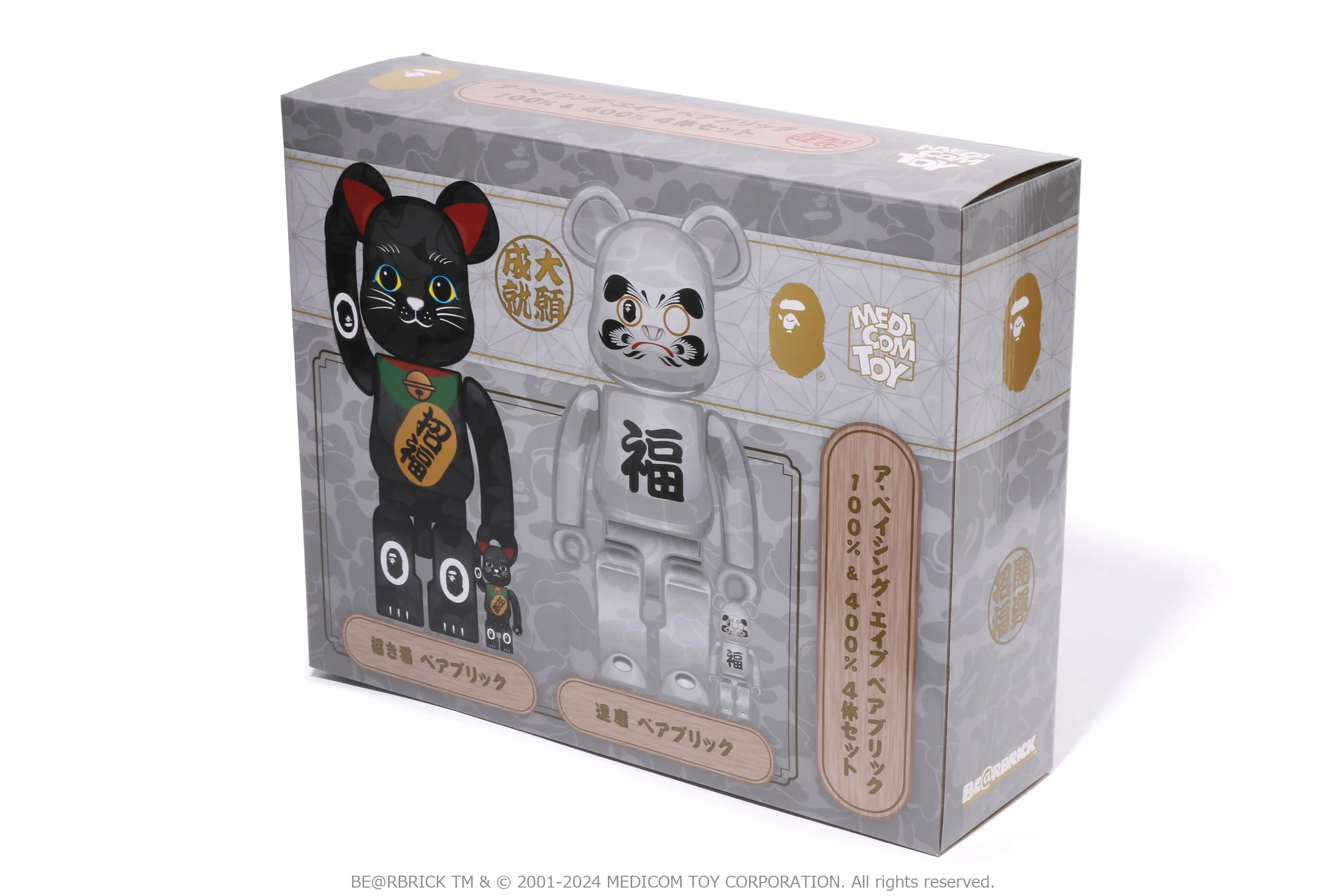
In July 2024, BAPE introduced a set combining a black-plated Maneki-neko and a white-plated daruma. Each appears in 100% and 400% sizes, making four figures altogether. BAPE CAMO and APE HEAD elements form part of the decoration.
Traditional symbols enter a conversation with streetwear here. The pairing contributes as much as the finish. Cat and daruma retain different faces and cultural associations while sharing one project.
For this release, it is useful to establish whether an offer concerns the complete set or an individual figure from it. Four objects and two sizes can be lost within a long product name. Seen together, they form a particular composition whose arrangement can be considered in advance.
BAPE
Peko-chan and further shades
The Maneki-neko motif also appears with Peko-chan, as confirmed by a 2021 Fujiya announcement. The cat’s attributes meet the confectionery company’s recognisable character in another interpretation.
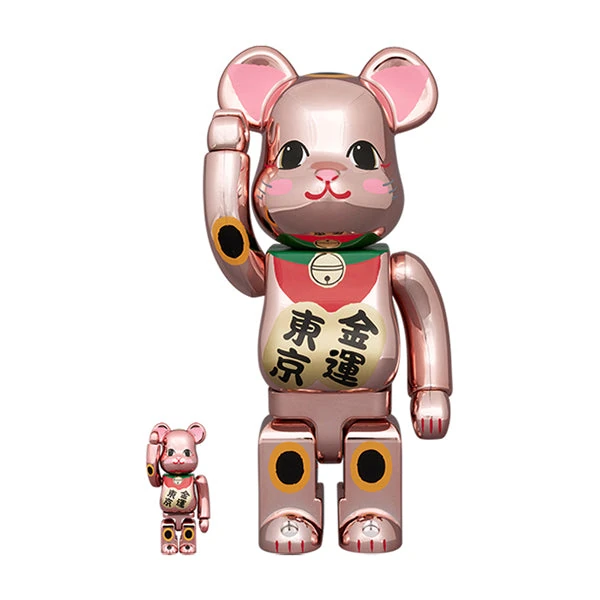
New finishes continue the story. In July 2026, MEDICOM TOY announced Maneki-neko Kinun Tokyo Peach Gold as a 100% and 400% set. It illustrates the value of keeping a full release name: closely related gold and pinkish surfaces can belong to different versions.
A collection need not follow every branch. One character, a particular finish or a small group of related shades can provide a personal thread as releases accumulate. The choice can stay selective without losing its connection with the broader motif.
Choosing a version and its place
Begin with what appeals most: the face, traditional graphics, reflections, illumination or wood. Then compare the dimensions with an actual place at home. A compact character and a large 1000% object fulfil different roles, even with similar decoration.
Consistent spacing can help a small group’s faces remain distinct. A larger figure benefits from a backdrop of its own. Check a reflective surface under ordinary lighting: a window’s reflection can affect its appearance more strongly than the colour of a neighbouring wall.
Before buying, establish the title, size, release date, finish or material, condition and contents. If an overall edition size has not been published, it can remain unknown. Enjoying the object does not depend on adding an unsupported number to its description.
A collection with a personal mood
Maneki-neko connects a recognisable Japanese tradition with changing design approaches. One figure recalls a ceramic cat at a shop entrance, another connects with furniture craftsmanship, and another brings the motif into fashion. Together they show how differently one idea can take shape.
A single cat whose expression appeals and whose scale suits the intended place is enough to begin. A later addition might bring another material or mood, if that connection is interesting. Completing every series need not become the goal.
The wish for prosperity can remain the collection’s cultural background, while colour, surface and form offer a reason to return to the object every day. Those particular choices are what make it personal.
Our BE@RBRICK size guide helps with scale. Explore Karimoku and BE@RBRICK × BAPE, or compare 400% and 1000%.