In this article
Where it began: Pooh before the big Mickey editions
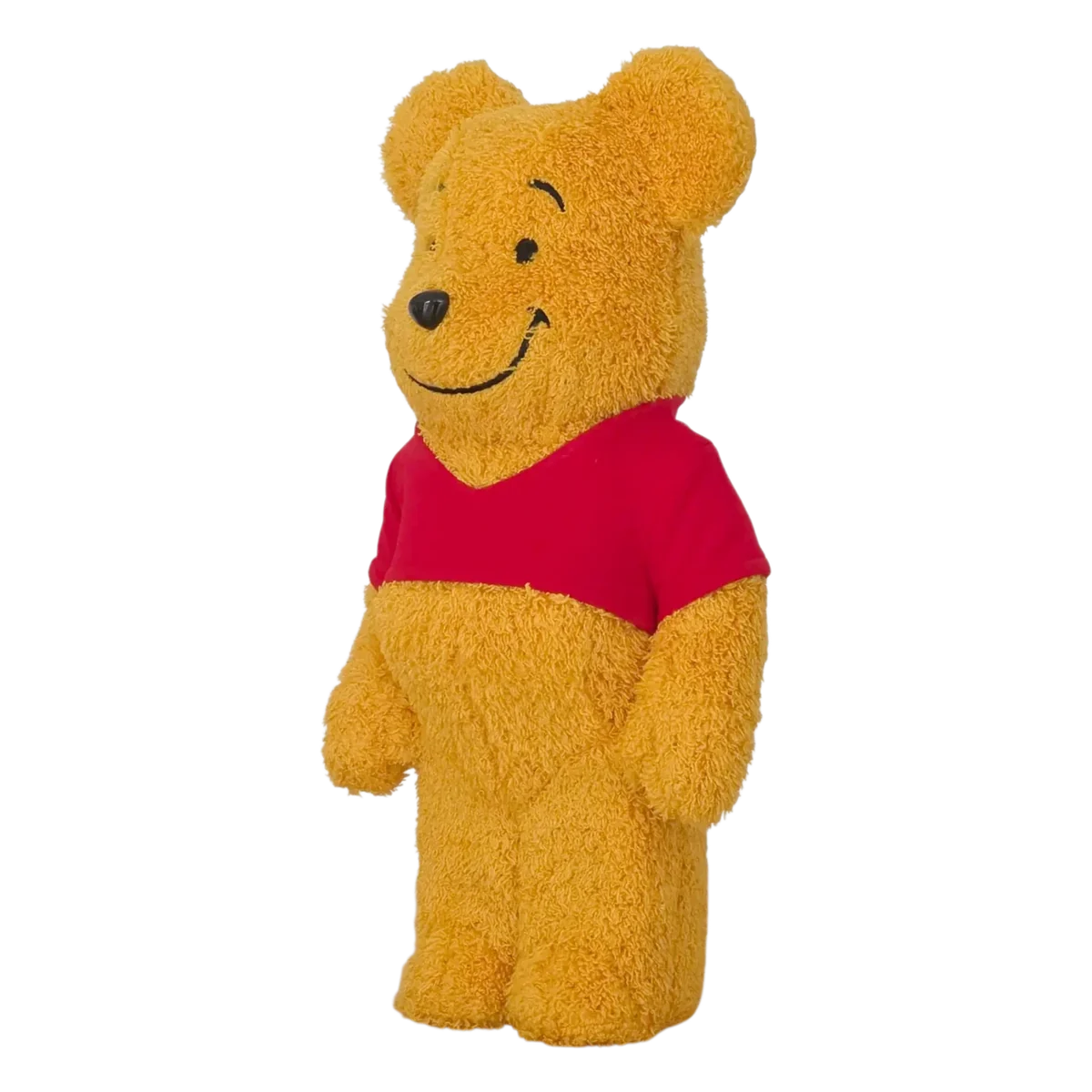
The BE@RBRICK platform began in 2001, and Disney entered its story early. MEDICOM’s official archive records a Winnie the Pooh 400% released on 19 May 2002 for World Character Convention 14. His yellow body and red shirt made him recognisable without replacing the underlying bear shape. This is a documented early point in Disney BE@RBRICK history, long before many of today’s familiar artist interpretations of Mickey.
The range subsequently developed through small series figures, larger individual releases, anniversary editions and designs by invited artists. It did not grow from a single boxed collection that every later figure belongs to.
A familiar character on an unfamiliar body
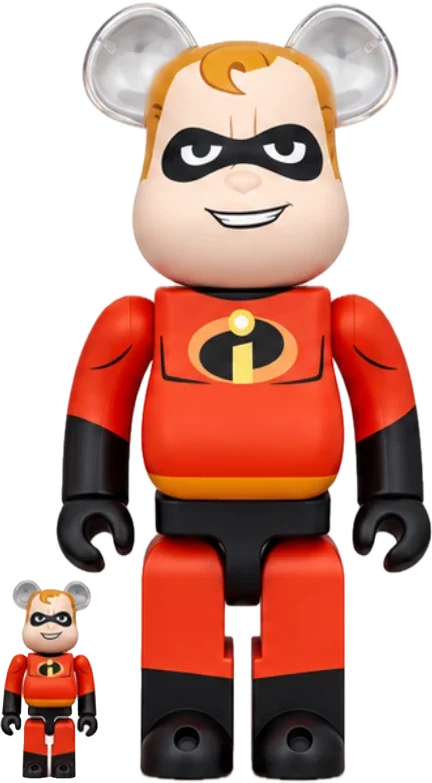
A Disney BE@RBRICK is not simply a miniature movie character. The bear-shaped platform retains its ears, rounded stomach and articulated limbs; the character has to emerge through colour, clothing, facial details and surface treatment. A red suit can make Mr. Incredible recognisable, while a pair of oversized eyes changes how we read Mickey. Comparing figures on the same body makes those design decisions unusually easy to see.
This guide concentrates on Disney animation and Pixar. Marvel has its own guide, and Star Wars deserves a separate discussion too. Even within that narrower field, there is no single continuous Disney collection to complete. It makes more sense to choose a character, an artist or a particular way of treating the surface, then follow that thread.
Which characters kept returning?
Mickey Mouse has the broadest range of interpretations in the archive we reviewed. He returns in classic colour, black-and-white versions, animation-inspired looks such as FANTASIA, and designs by fragmentdesign, BAPE, Sorayama, Calleja and other artists. The changes go beyond scale: one edition centres on a costume, another on facial drawing, another on a reflective finish. A collection devoted to one character can therefore contain very different objects.
Winnie the Pooh also has a long history of returns, from the early 2002 figure to contemporary Pile Fabric costumes and ORIGINAL versions. Minnie has releases of her own, while Toy Story’s Woody and Buzz recur within the Pixar range. These are established strands rather than a numerical ranking: we have not counted every size, recolour, lottery prize and regional edition. Together they show how Disney BE@RBRICK develops by revisiting familiar characters as well as introducing new ones.
Returns are also visible elsewhere in the range. Minnie has a 2018 black-and-white release alongside colour editions, while Stitch appears as a 2018 400% figure and a 2025 Costume Ver.. Donald, Goofy and Angel broaden this circle, making it possible to build pairs and small groups around familiar character relationships.
Start with the Mickey you actually remember
Mickey is a useful starting point because the costume carries a great deal of the story. A classic colour scheme, a monochrome interpretation and a film-specific outfit can share a silhouette yet feel very different on a shelf. Before comparing prices, decide whether you are drawn to animation history, to a particular scene or simply to the graphic balance of the object.
The official FANTASIA MICKEY listing documents a 100% and 400% pair. That is one recognisable direction within a much broader family, rather than the definitive Mickey. Names such as FANTASIA, B&W or a collaborator’s name should stay attached to the exact edition: “Mickey BE@RBRICK” alone tells you too little when several apparently similar figures are being compared.
fragmentdesign: the character becomes a colour study
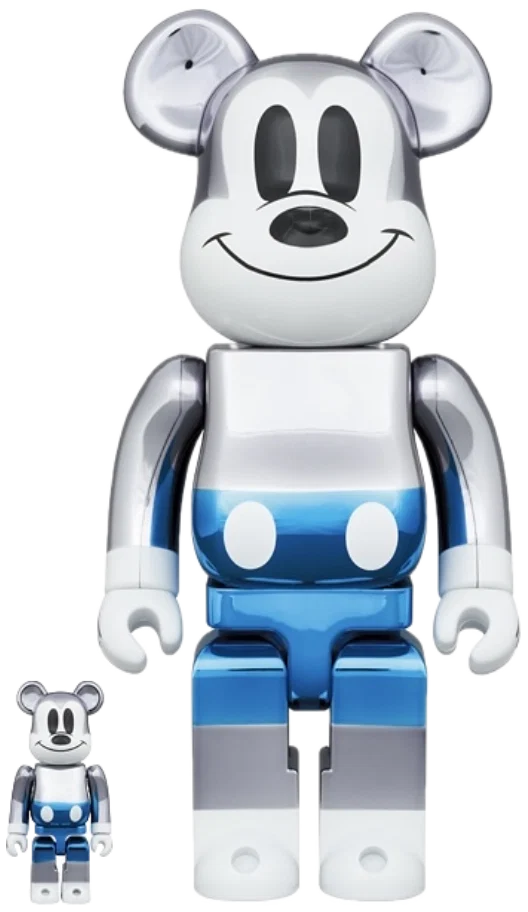
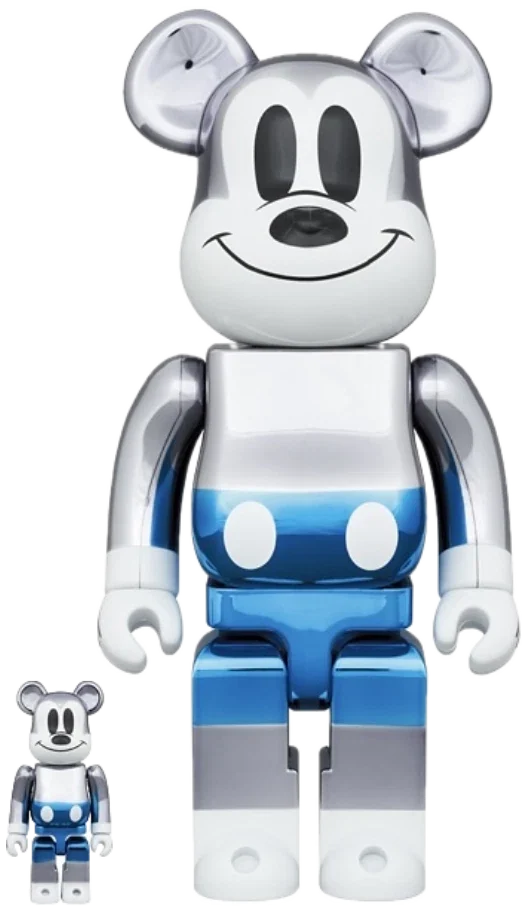
On fragmentdesign Mickey Mouse Blue Ver. 400% + 100%, blue makes the first impression. Familiar clothing remains readable, but the figure can also be seen as a compact arrangement of reflective colour. From across a room, the overall finish may register before the expression; up close, smaller printed details bring the character back into focus.
The MEDICOM archive connects BLUE Ver. with MEDICOM TOY EXHIBITION ’23. This particular version should not automatically inherit the dates of earlier fragmentdesign Mickey releases. Look at the back too: the collaboration is not limited to the front-facing image. The 1000% version allows the same visual idea to work at a different distance. Choosing between the two is as much a question of viewing space as of collecting preference.
Javier Calleja: a small change with a different mood
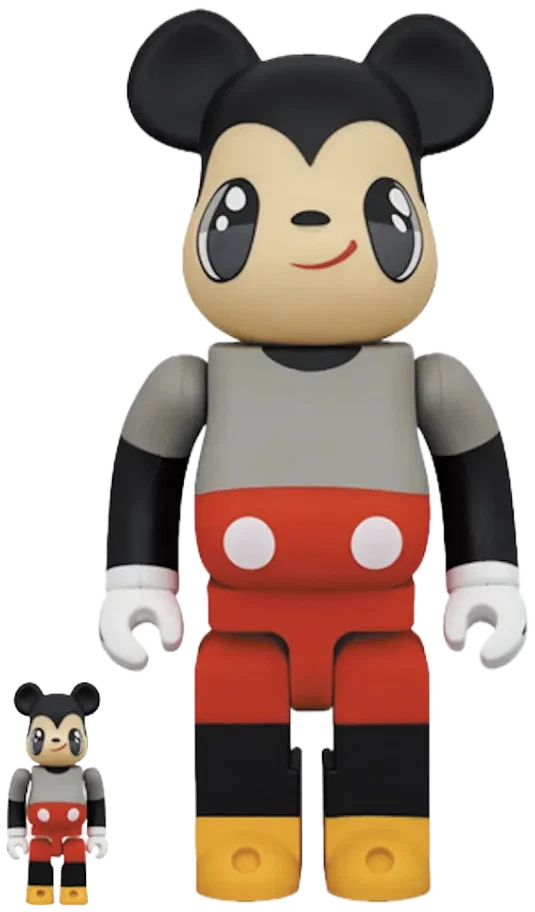
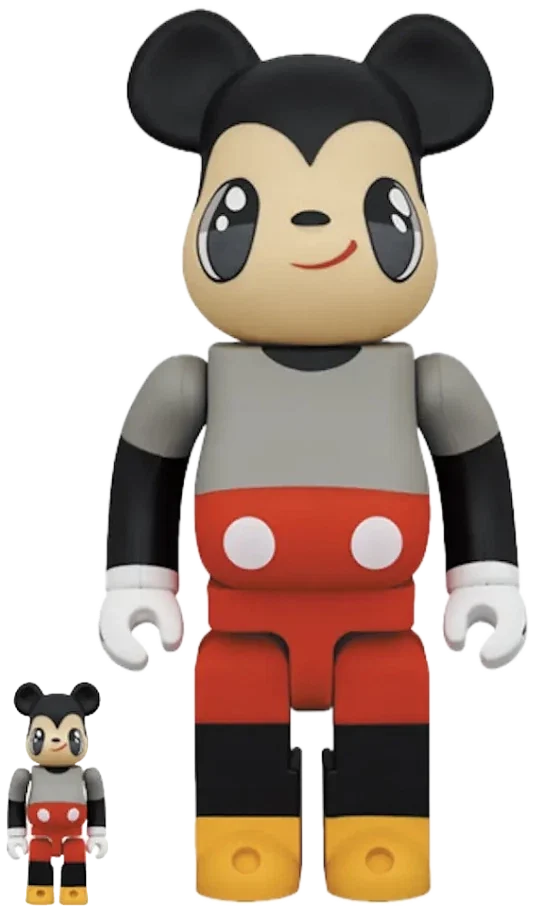
Javier Calleja’s Mickey places particular emphasis on the eyes. Much of the familiar outfit remains, so the altered face carries the change in mood. It is an effective example of an artist edition that does not need a completely new body or an all-over pattern to be distinctive. Beside another Mickey, its expression becomes the point of comparison.
The official MEDICOM archive identifies the 100% and 400% set as a 2G exclusive, announced for November 2021. Our Calleja 400% + 100% page shows that pairing; the 1000% figure offers a larger reading of the face. The artist’s name is useful here as a design attribution, not as a promise about future market value.
Future Mickey: reflections are part of the image
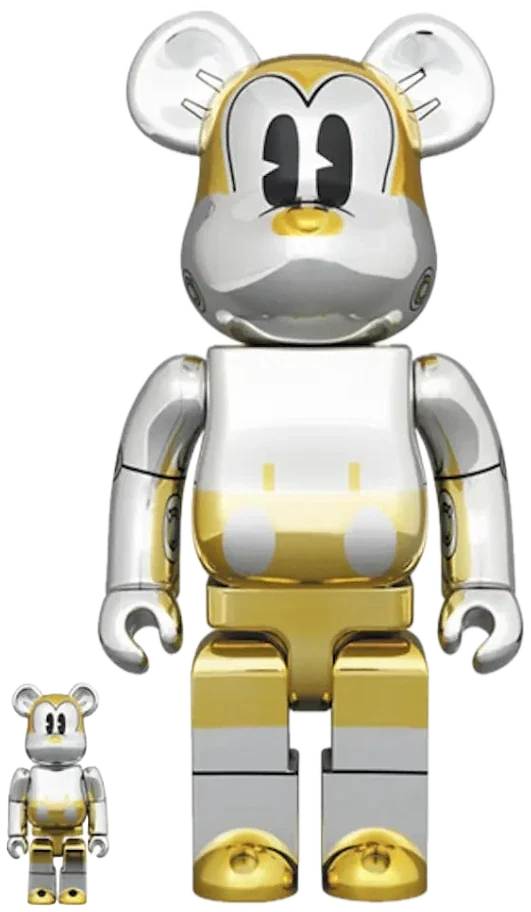
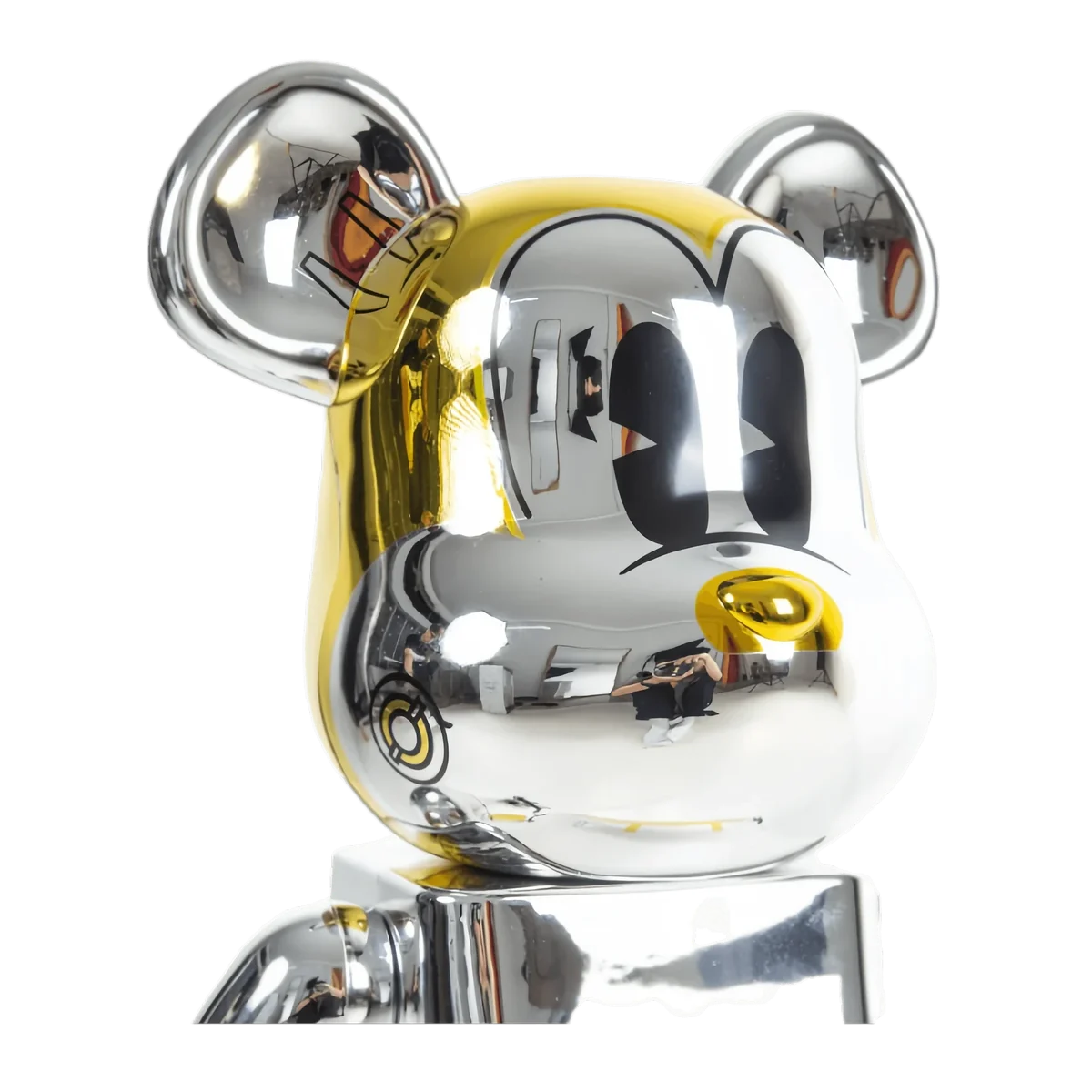
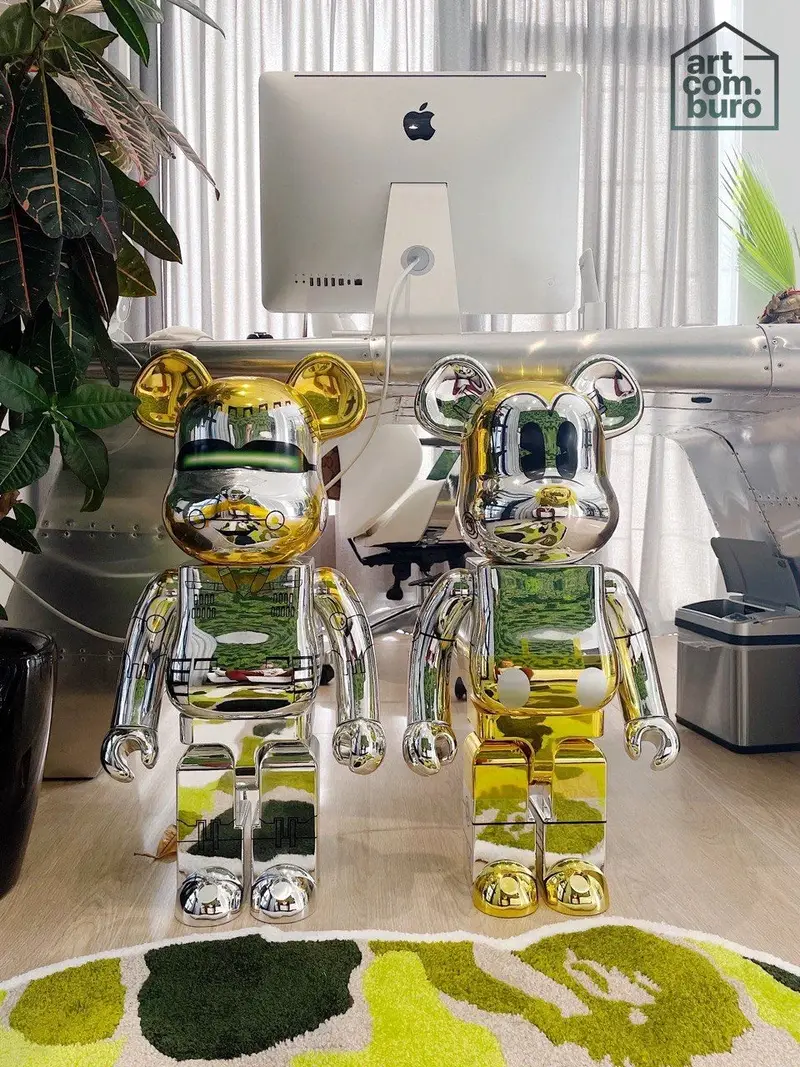
Hajime Sorayama’s Future Mickey moves toward a mechanical-looking character. On a reflective finish, light picks out curves and seams, while the room appears in the surface. This makes a chrome-looking figure more sensitive to its surroundings than a flat printed one. A quiet background can make it look precise; a crowded shelf can turn the same surface into a busy patchwork of reflections.
The Future Mickey Gold & Chrome 400% + 100% set and Future Mickey 1000% illustrate different scales of that approach. Always check the full version name rather than treating every Future Mickey as the same release. MEDICOM’s FUTURE MICKEY 2021 announcement is a separate edition record. A metallic appearance alone does not establish what the body is made from.
Future Mickey also has a history outside BE@RBRICK. AISHO gallery’s artist biography lists Sorayama’s Disney × TOMY “BDhyp. FUTURE MICKEY” project in 2003. This was a separate project preceding later editions on the bear-shaped platform. The artist’s mechanical Mickey therefore has a longer history than any one MEDICOM figure.
Photographs
BAPE Mickey: follow the particular collaboration
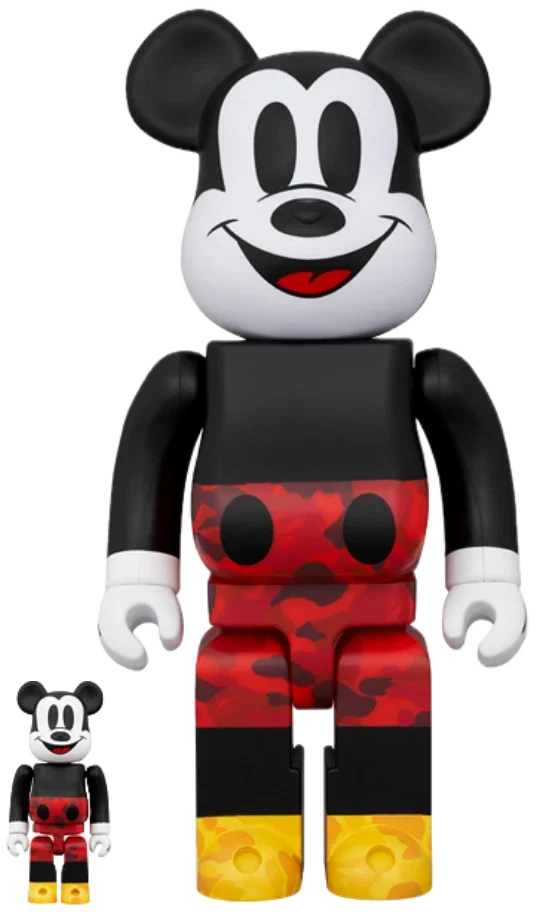
BAPE introduces another collecting route: the meeting of a character and a fashion brand. Here it helps to be exact. The BAPE Mickey Mouse Color Ver. 400% + 100% set should be considered as that named edition, rather than folded into every BAPE camouflage or SHARK release. The shared brand name does not make their graphics, characters or presentation interchangeable.
The brand’s 2020 press release recalls green, blue and pink versions in 2019, followed by Monotone in 2020. The 2023 anniversary announcement introduces a later red-camouflage design. BAPE Mickey is therefore a sequence of distinct editions, not one object whose date and colour can be exchanged freely.
You might build a small Mickey group around three different approaches: fragmentdesign for colour, Calleja for expression and BAPE for a fashion collaboration. That creates a coherent comparison without requiring identical finishes. Alternatively, a single BAPE Mickey can sit with books or clothing-related objects and make sense through that personal connection. A collection is often easier to live with when it has a clear reason for growing.
Photographs
From Sorayama to Haring and Tanaami: rethinking Mickey
Sorayama approaches Mickey through a mechanical character and reflective surfaces. fragmentdesign puts colour and graphic marks in the foreground; Javier Calleja changes his expression through enlarged eyes; BAPE connects him with its camouflage language. These are different approaches to a recognisable figure, rather than simply a sequence of alternative colours.
Keith Haring Mickey Mouse belongs in this story too. It transfers Haring’s drawing of Mickey onto BE@RBRICK, with the official edition crediting the Keith Haring Foundation and licensing by Artestar. That is distinct from the artist personally developing a later toy: the release makes licensed use of his artistic legacy.
Keiichi Tanaami Mickey Mouse offers another artist’s interpretation. MEDICOM announced the 100% and 400% pair for 2G in November 2021. Comparing Tanaami, Haring, Calleja and Sorayama helps explain the appeal beyond animation nostalgia: a familiar character becomes a meeting point for art, design and animation.
Beyond Mickey: Minnie and Winnie the Pooh
Mickey is a centre of gravity, not the whole Disney range. MEDICOM has also documented MINNIE MOUSE releases, allowing a display to follow a relationship between characters rather than several versions of one face. Minnie and Mickey need not be matched in every colour or size; a deliberately chosen pairing can be more engaging than a crowded attempt to include everything.
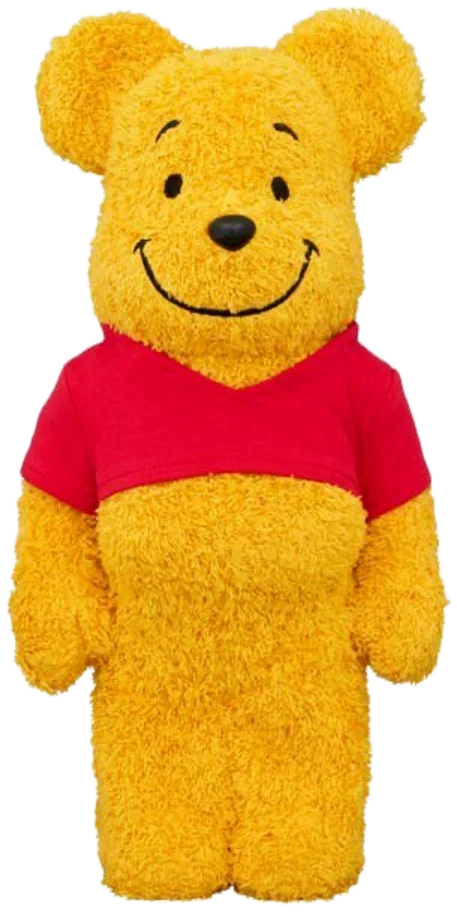
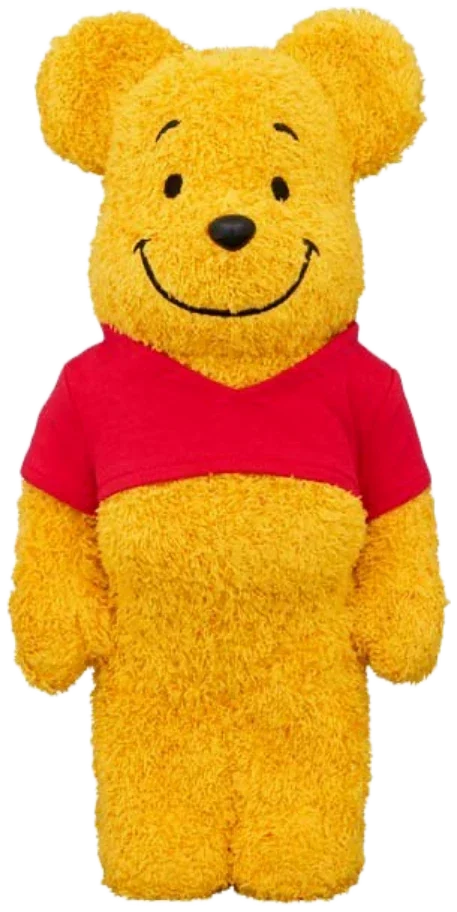
Winnie the Pooh takes the discussion toward texture. The full name of our Winnie the Pooh Costume Ver. (Pile Fabric) 400% matters: a costume treatment is a different visual proposition from a smooth printed surface. An official pile-fabric 400% record provides an edition reference. Do not collapse every Pooh into one model: a photograph without a scale reference can disguise differences in size, while a similar colour does not establish identical construction.
Photographs
Pixar: a different character vocabulary
Pixar opens the guide beyond Mickey’s familiar proportions. On Mr. Incredible 400% + 100%, the red outfit, black mask and chest emblem do much of the identification. It is a useful contrast with Future Mickey: one design depends on immediately legible costume graphics, the other invites you to notice how the light moves across its finish.
Toy Story provides another route through Woody and Buzz Lightyear. The official Woody 400% page identifies an approximately 28 cm figure; that concrete edition is more useful than assuming every Toy Story character is sold in the same format. A Pixar collection can follow a favourite film, or compare how very different characters are translated onto one platform. Both approaches leave room to be selective.
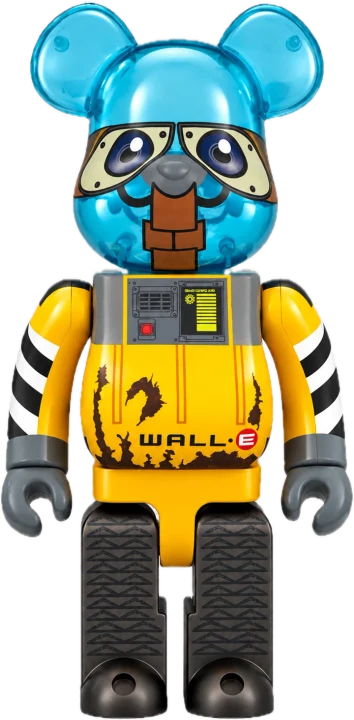
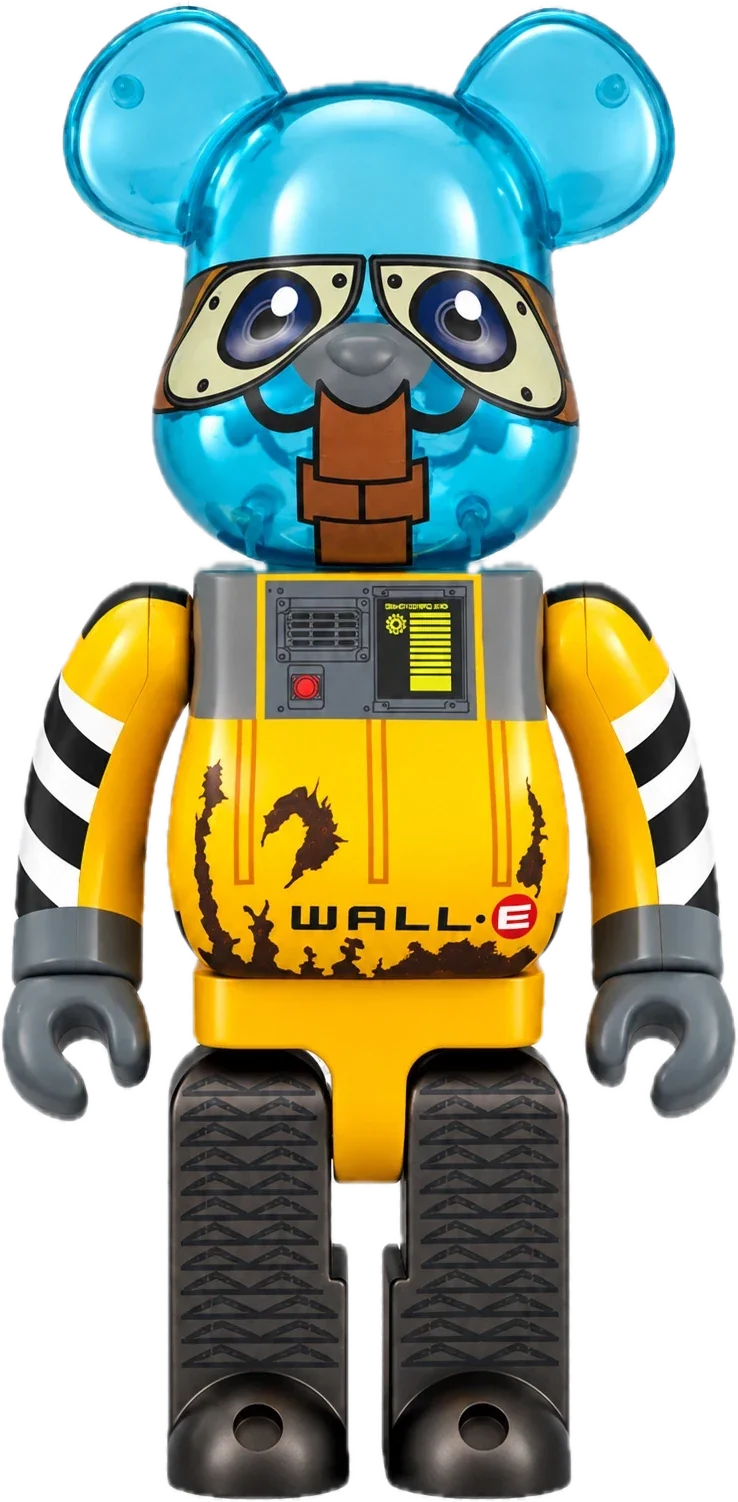
WALL·E brings another recognisable design into the group: the expressive binocular-like eyes and the little robot’s graphic details have to coexist with the bear silhouette. Compare our WALL·E 1000% with the red-suited Mr. Incredible to see how differently two Pixar characters can occupy the same platform. MEDICOM documents WALL·E at approximately 70 cm, while its Mr. Incredible archive records a 100% and 400% pair.
Photographs
100%, 400% or 1000%: choose the viewing distance
The familiar reference heights are approximately 7, 28 and 70 cm. They describe three very different relationships with a room. A 100% figure rewards close looking; a 400% has enough presence to stand beside books; a 1000% can become an independent visual anchor. Confirm the dimensions of the exact release, since costume treatments and other construction details may change the space it needs.
A label reading 100% & 400% describes a two-figure set; 400% alone does not automatically include a miniature. That distinction is easy to miss in photographs. Before choosing, measure the intended position, including the space around the ears and beside the arms. Our guide to art toys at home discusses grouping and placement. For miniature collections, a display case can provide order without filling an entire shelf.
Build a display around what you enjoy noticing
For a first Disney grouping, choose one clear conversation: three Mickey interpretations, a pair from a favourite film, or a contrast between a reflective finish and a textile-covered figure. Leave enough space for each outline to remain readable. A wall, a few book spines or an uncluttered cabinet often gives more to the display than another row of unrelated objects.
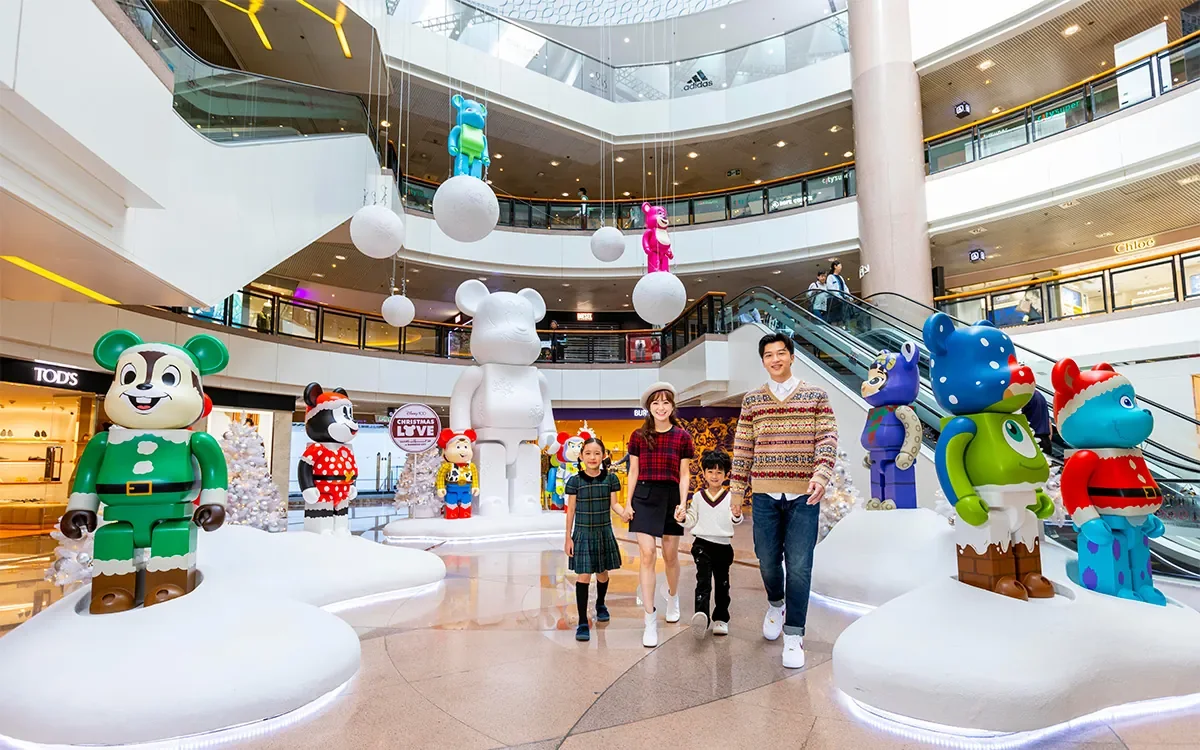
Disney can also operate at exhibition scale. Our Disney100 2000% article looks at that larger project separately; those installation images are not a size guide for an ordinary shelf. For a personal collection, the more useful question is which version you will still want to look at closely. Check its exact name, size, included figures and condition, then choose the place where its particular character can be seen.