In this article
Identify the release you are being offered
BE@RBRICK has a recognisable silhouette, but many different constructions and finishes. “What does a real Bearbrick look like?” is therefore too broad a question. You need the collaboration, colour, size, approximate release year and original contents. Establish whether the listing is for a single figure or an official set. A manufacturer’s product page is a useful reference; a similar bear in somebody else’s listing is a weaker starting point.
Compare the seller’s description with the documented release. For a 100% + 400% set, ask to see both figures and their shared inner tray. For a separately released 400%, do not demand packaging from an unrelated set. Check the combination of design and size: the same artwork may have appeared in several official formats.
An original in good condition, a repaired original and a counterfeit are three different possibilities. A scratch does not make a figure fake. Equally, a genuine box does not authenticate whatever is inside it. Separating these questions makes it harder to mistake good presentation or good condition for evidence of origin.
When did counterfeit BE@RBRICK figures appear?
A NikeTalk discussion dated 8 May 2009 already asks how to check a BE@RBRICK. This documents an early discussion, not the start of counterfeit production. The first factory cannot be identified from the available evidence.
Do not confuse an original figure’s release date with the date a copy was manufactured. A design launched ten years ago could have been copied much later. A copyright date also does not tell you when the seller acquired this particular example. A short chronology is more useful: the official release, purchase records, subsequent owners and photographs of its condition.
An old image labelled “fake bear” needs checking too. A bear made by another brand is not automatically a counterfeit BE@RBRICK. Establish the maker and model before discussing deviations in shape. Otherwise, a seemingly persuasive comparison may simply place two different toys beside one another.
NFC arrived in BE@RBRICK in 2022
Medicom Toy and Hakuhodo Products announced du-al.io on 20 July 2022. The first three compatible BE@RBRICK products followed on 23 July 2022; TOPPAN confirms an NFC tag inside the right leg.
This covers supported releases, not every BE@RBRICK made after 2022. The tag is read by bringing a phone close to it; early models need not support it. TOPPAN’s May 2021 milestone was its platform launch for China, not the introduction of chips in these figures.
Request a continuous video showing the item, the scan and its result. An official OPENERS report documents the demonstration. A verification screen supplements a condition check rather than replacing it.
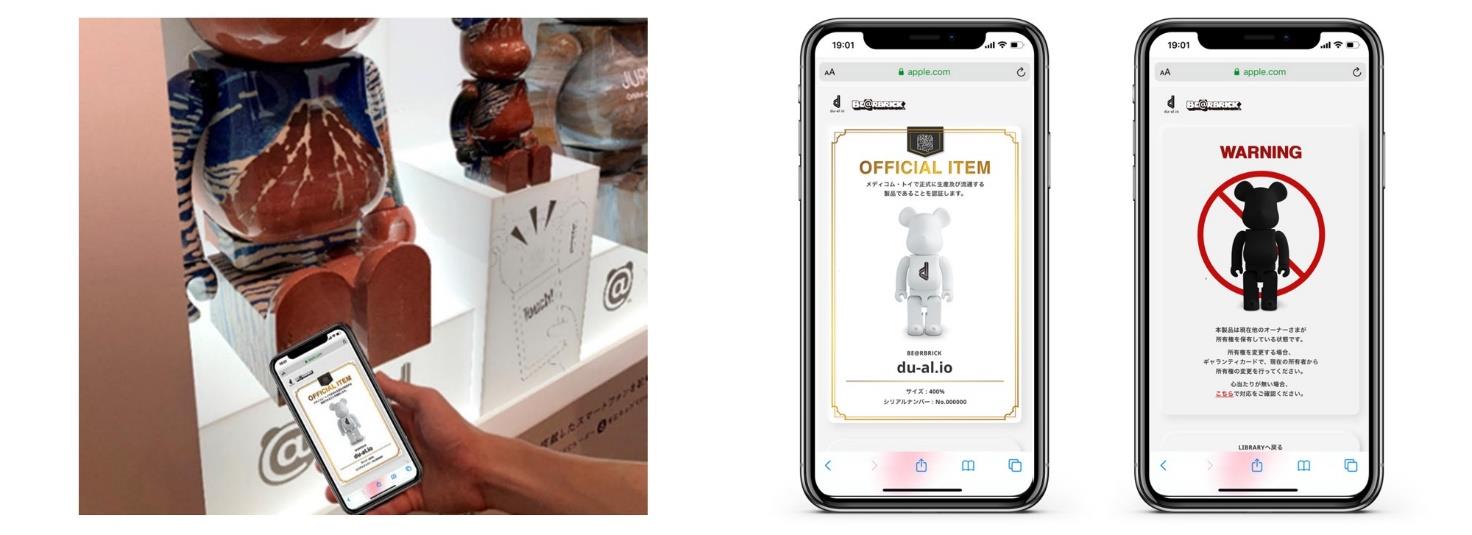
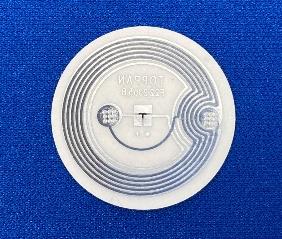
The separate component photograph shows a TOPPAN NFC tag from its official press release. A supported BE@RBRICK contains the tag inside its right leg; the accompanying demonstration shows the phone scan.
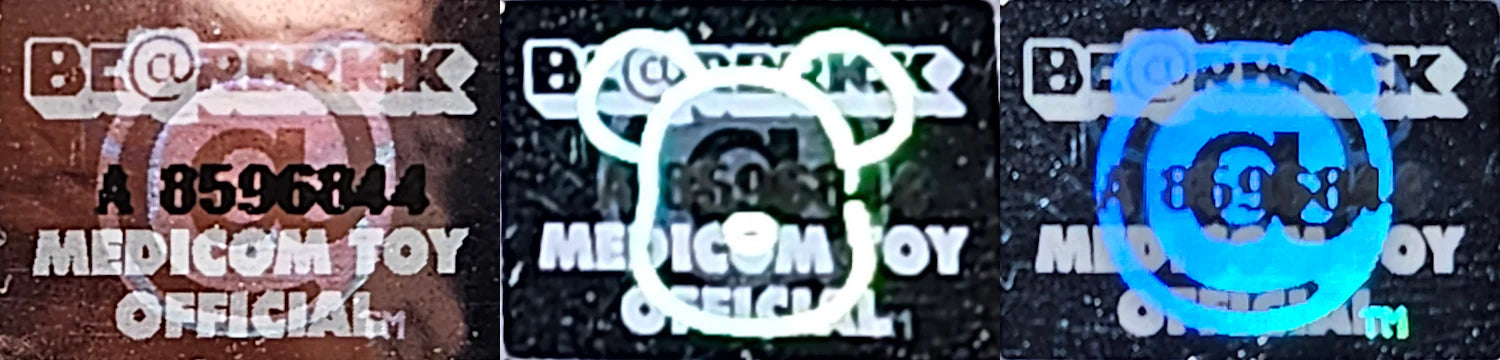
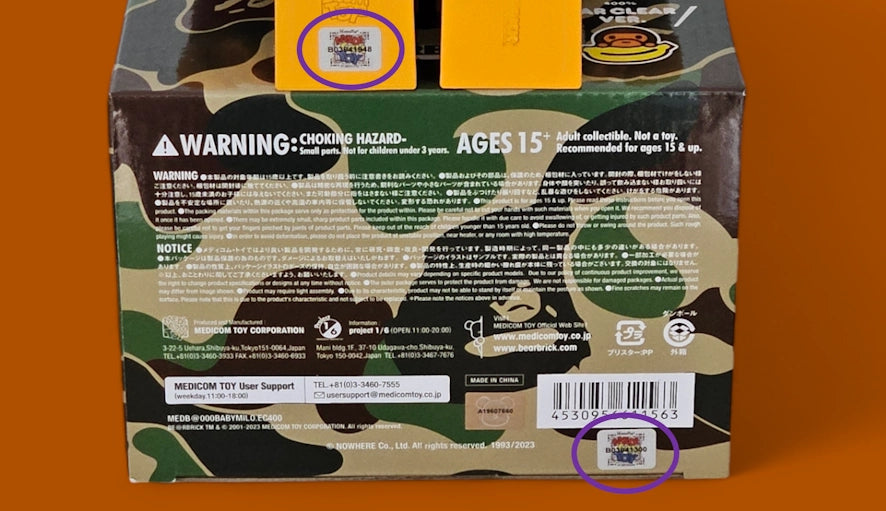
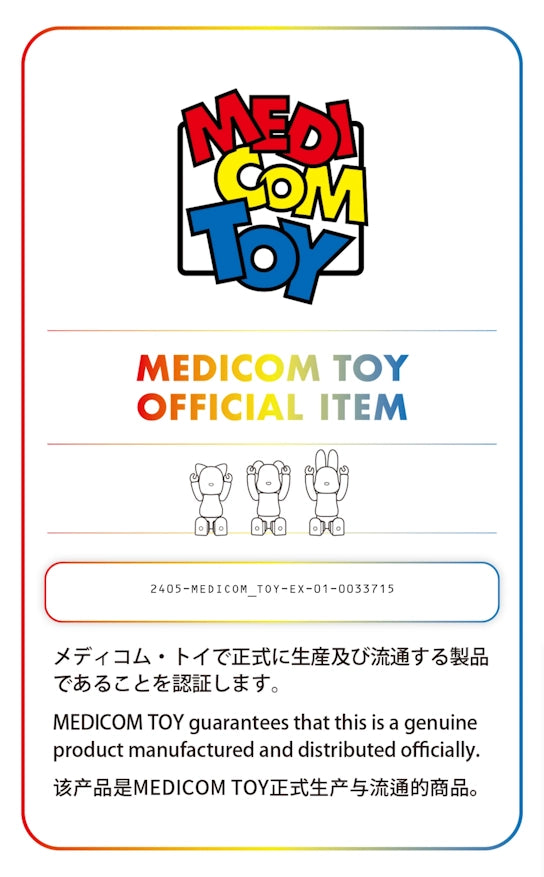
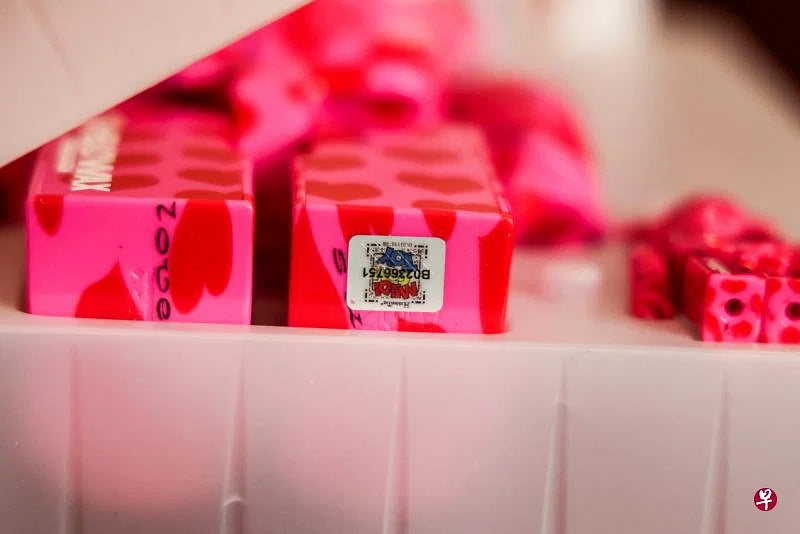
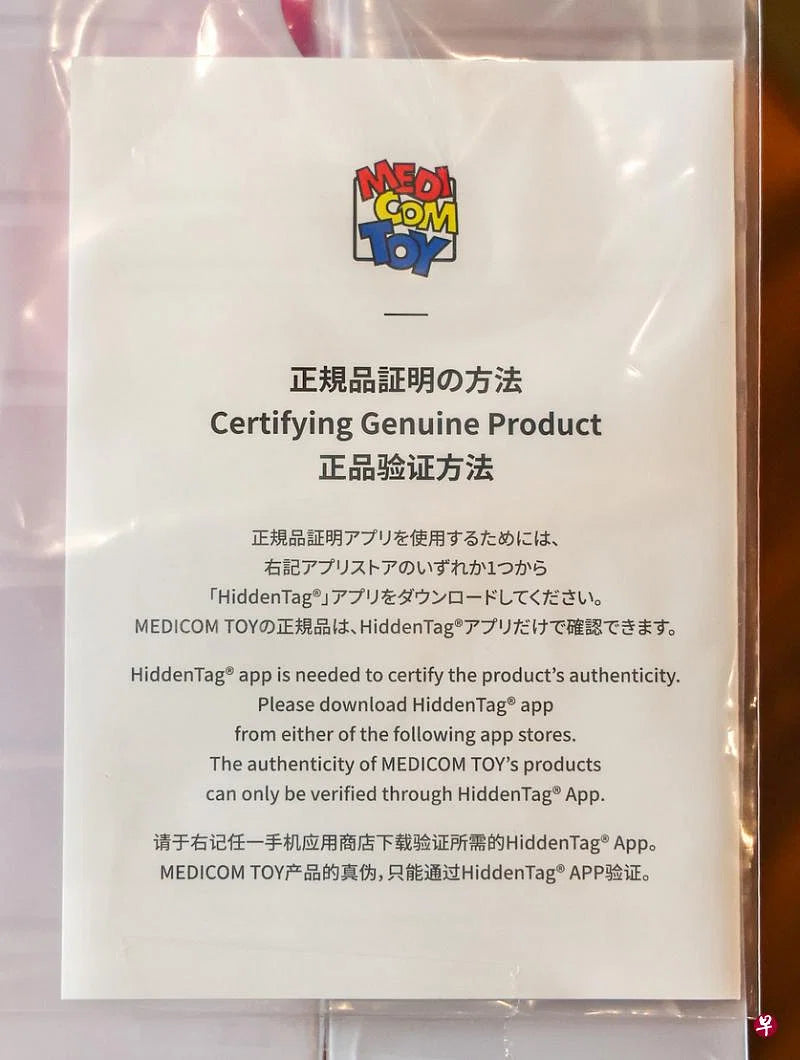
A hologram, HiddenTag and NFC are different things
A ThinkChina / Lianhe Zaobao report places HiddenTag adoption around late 2021–early 2022. It is separate from NFC: HiddenTag’s developer describes scanning the label with its app.
| What you are looking at | How it is checked | What to establish |
|---|---|---|
| Holographic label | Its visual effects change as the angle and lighting change | Whether this release should have that label, and where |
| HiddenTag | An optical label is read with a camera through the relevant service | It is not another name for every NFC chip; follow that system’s instructions |
| du-al.io | A phone reads the NFC tag in a compatible figure | Whether the specific model is supported and the service returns the appropriate result |
Do not identify the protection system from one word in a listing. A seller may write “NFC” beside a photograph of an ordinary sticker. Ask to see how it is read. Do not peel off a label as an experiment: damaging it makes inspection harder without explaining the figure’s origin.
What the security labels look like
Legs, body and silhouette: where a crude copy shows
Start with front, rear and side views. Compare head-to-body proportions, ear shapes, the gap between the legs and hand positions. With a crude copy, the silhouette can be more revealing than the explanation: poorly defined transitions, unusually narrow feet, a leaning torso or legs that look distorted by heat.
Compare photographs taken from similar angles. A high camera position makes the head look larger, while a wide-angle lens can stretch the nearest foot. Ask the seller to place the figure upright, step back and photograph it without a steep camera tilt. A short video moving around the object is useful alongside a carefully composed front view.
Check stability on a level surface and ask to see the joints. A conspicuous gap, excess material or a pronounced lean deserves an explanation. Do not force the arms and legs through their movement or dismantle the bear for a home inspection. Damaging a genuine object will not make the conclusion more reliable.
A “melted plastic” appearance describes what you see, rather than proving its cause. Poor casting, damage or repairs are possible explanations. Storage matters too: the Canadian Conservation Institute discusses deformation of certain plastics as an effect of unsuitable temperatures. Assess condition separately from authenticity.
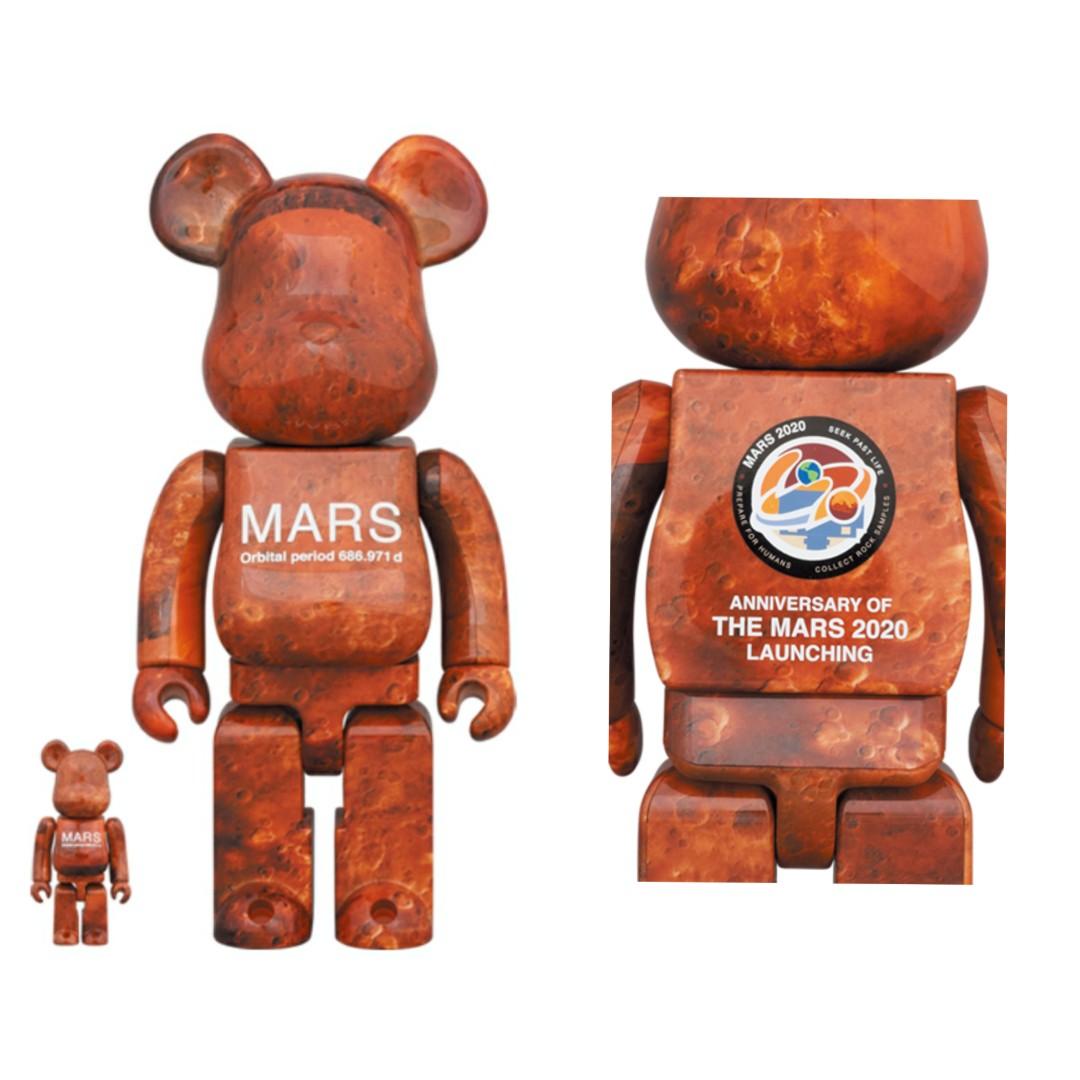
MARS: distorted proportions and a misspelling
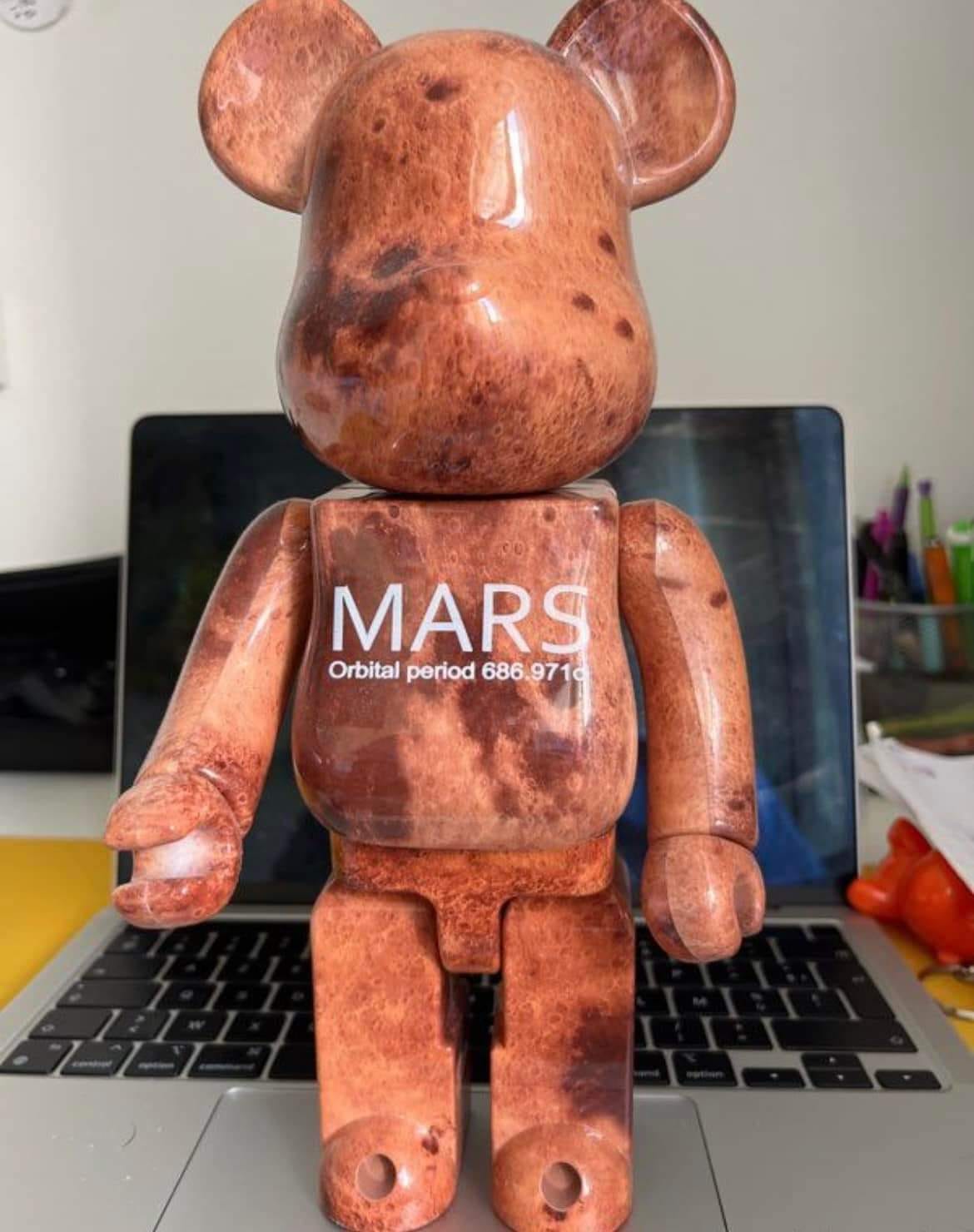
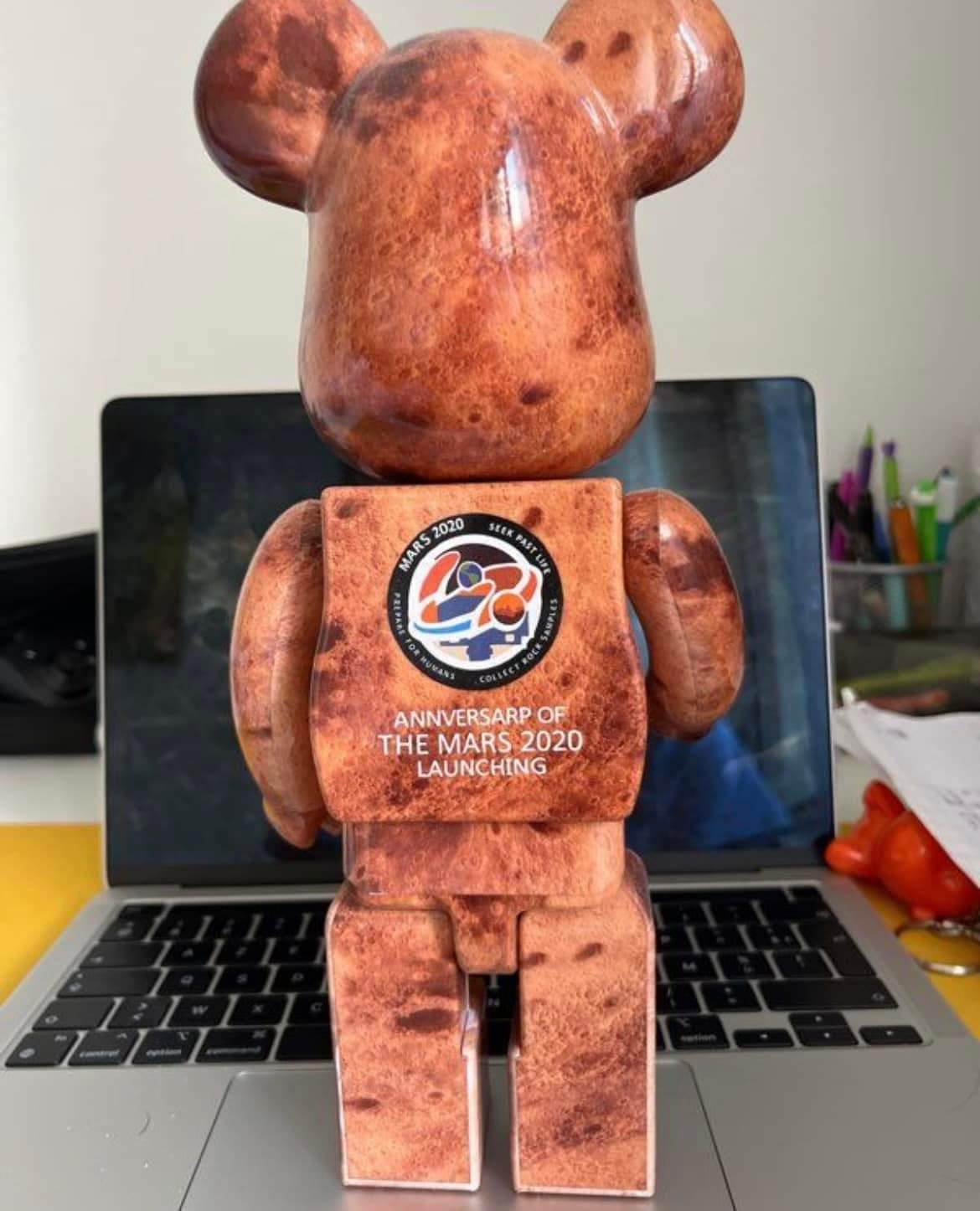
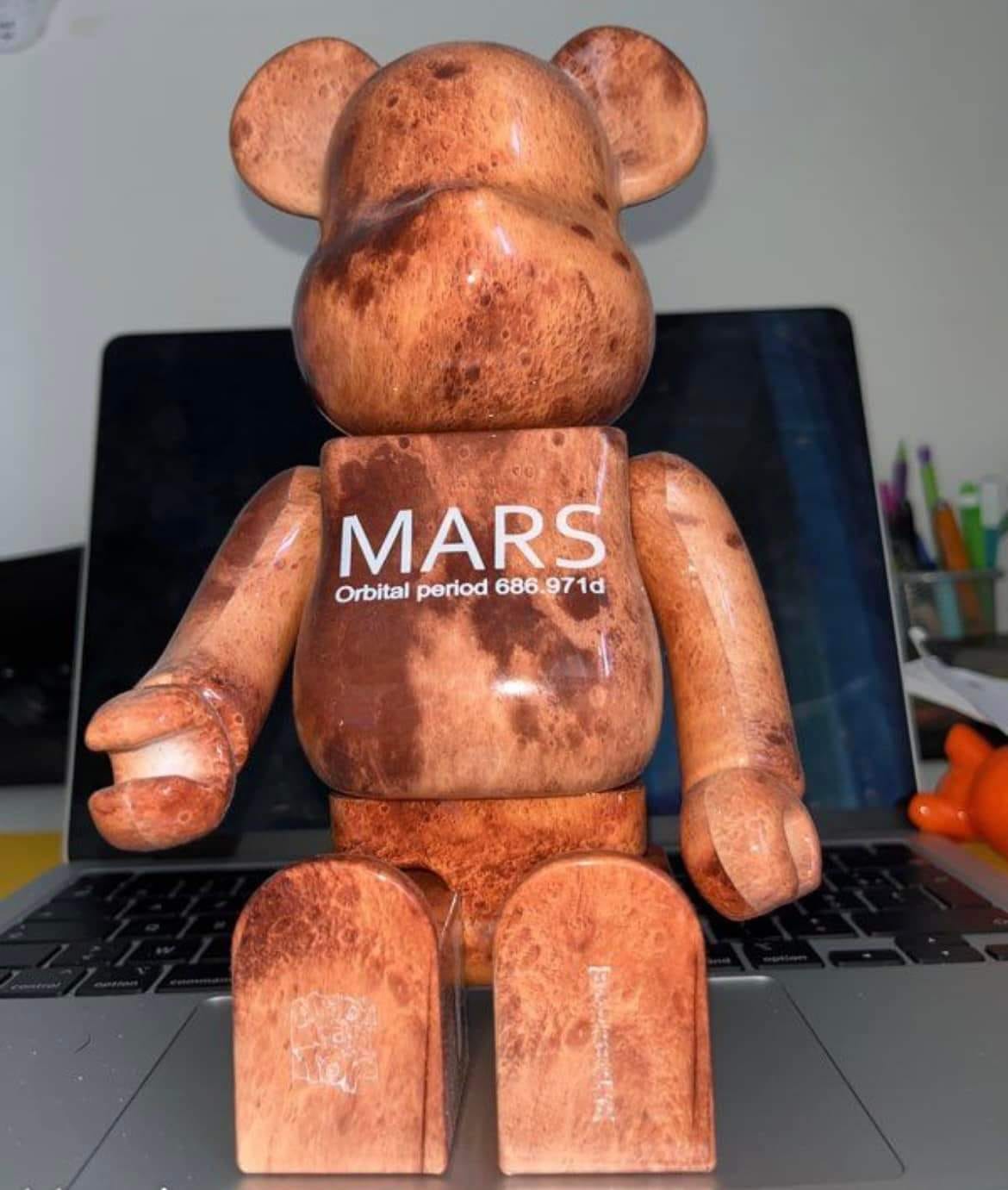
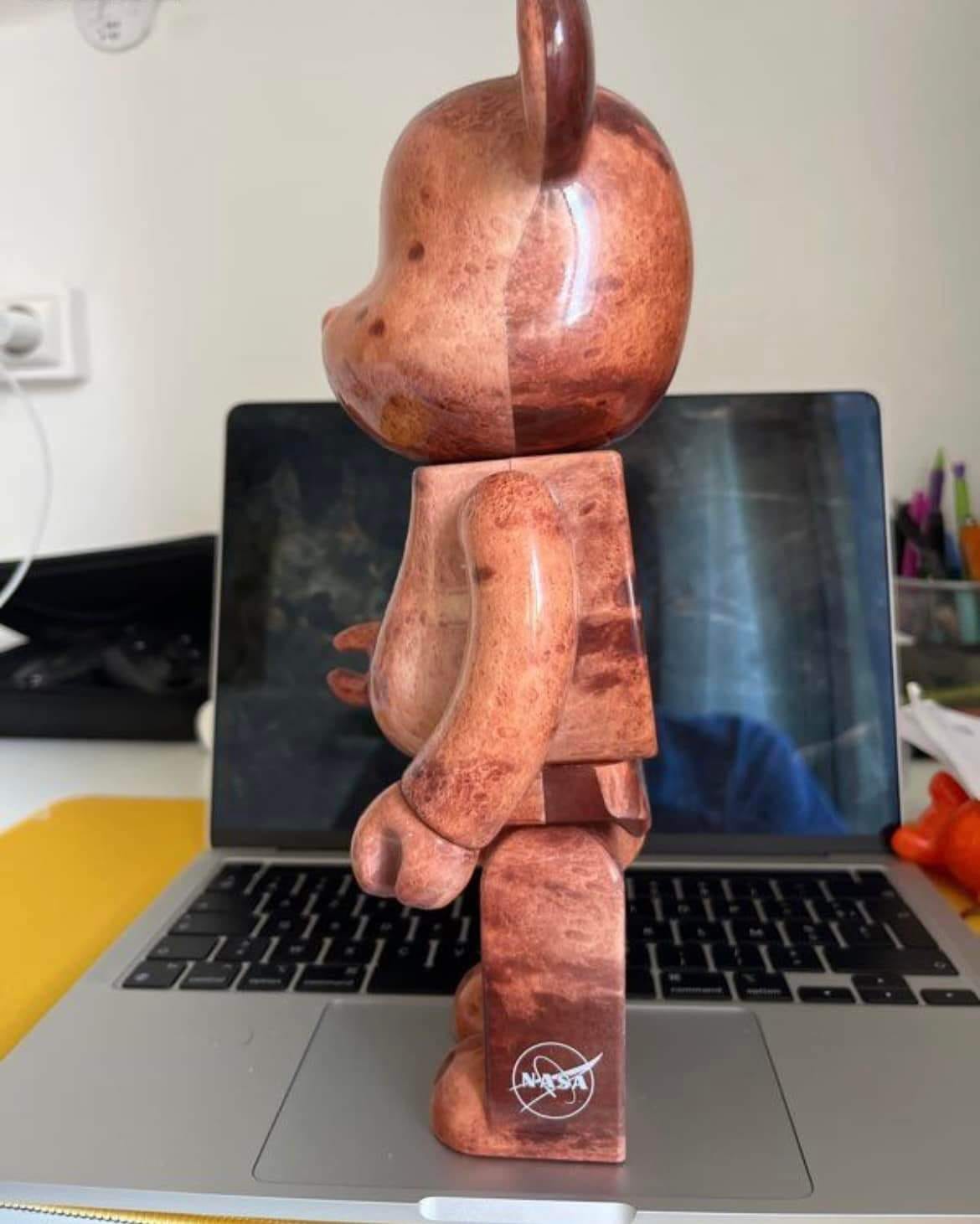
Drunkenbears shows four views of a counterfeit MARS, with elongated legs and “ANNIVERSARP” on its back. The catalogue reference is separate; the photographs are not a measurement scale.
MARS: four views of the counterfeit
Plastic and finish: shine alone tells you very little
Japanese retailer BRING recommends examining material, surfaces, markings and moving joints. These are useful areas to inspect, rather than a promise of one universal test. Instructions for the particular model are more helpful than a formula such as “originals are heavy and click; fakes are light and soft”.
First establish the material of the release. A wooden KARIMOKU should not be assessed like a standard plastic bear: OPENERS’ factory report documents woodworking, hand finishing and assembly. Expecting the same weight, surface and sound would be misleading. Our KARIMOKU article explains the distinction in more detail.
On a plastic figure, inspect printed boundaries, joins, adhesive traces and areas around openings. Judge colour under neutral lighting, without filters. A substantial colour difference between photographs warrants more pictures, rather than an instant conclusion. Chrome surfaces reflect the room, the phone and the photographer particularly strongly.
Originals age too. Esquire China’s interview with collector Gao Ke mentions older figures in his collection that had yellowed. CCI explains that plastics change according to their composition and conditions. A promise that genuine BE@RBRICK figures never fade or discolour is unreliable.
An artist’s repaint is another distinct situation. The Esquire interview also describes artists transforming ordinary figures. Such an object should be described as a custom, identifying the artist and base, rather than presented as an official production collaboration. Authenticating the base and establishing who made the new decoration become separate questions. Ask whether photographs before the alteration and records of the artist’s work survive.
A different print position is not always a counterfeit sign
A printing fault is different from permitted variation. In the official BE@RBRICK PUSHEAD 1000% product description, MEDICOM TOY explicitly notes that water-transfer printing creates differences between individual examples. A colour patch appearing somewhere different from the catalogue image is therefore not sufficient evidence of a counterfeit.
Before highlighting a discrepancy with an arrow, establish how the decoration was applied. Compare the printing technique, design and construction of the same release. Otherwise, you may wrongly demand an exact match between every line on two genuine figures. Be particularly careful with attractive comparison boards whose identical frames conceal different camera scales and lighting.
Documented examples: what has actually been compared
Eye For Toys examined BAPE × Mastermind, B@BY Pastel, B@BY Water Crest and MoMA The Starry Night in 2021. These are documented cases, not a ranking of counterfeit volumes.
Match the contents, finish and decoration to one release. A figure from an official set may be sold without its companion, provided that the missing item is disclosed. An incomplete set and a counterfeit origin are separate questions.
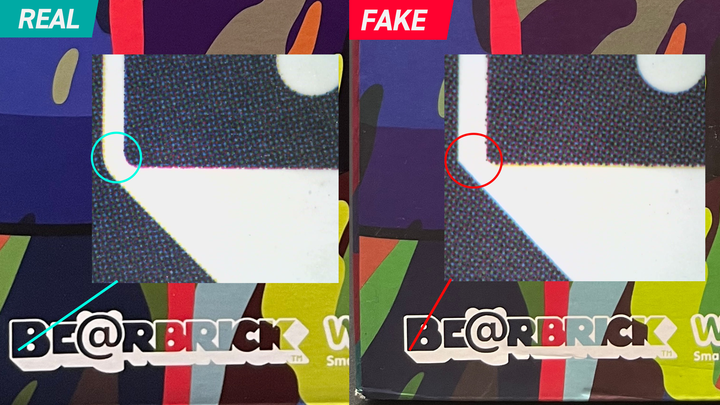
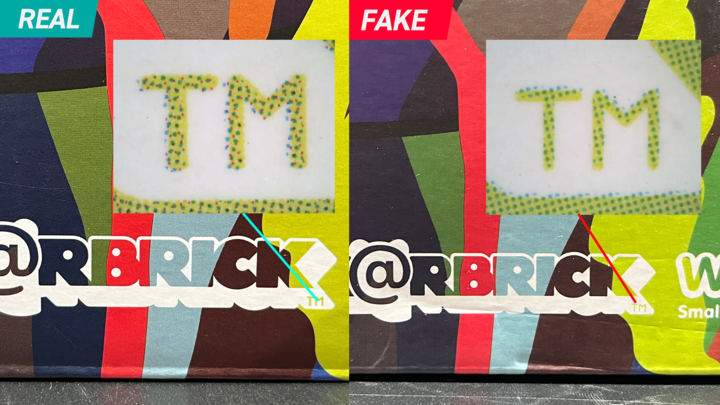
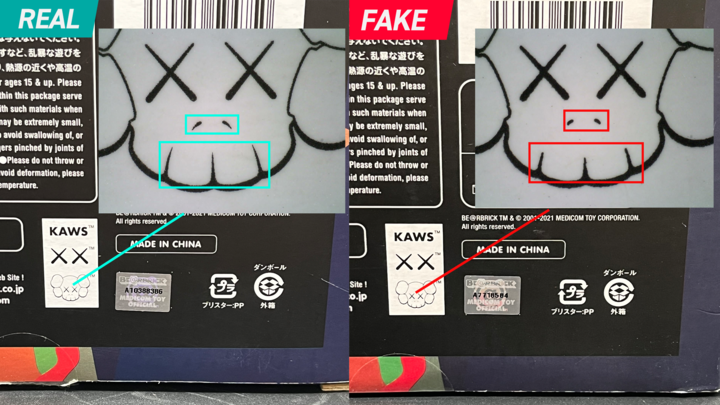
KAWS TENSION: a counterfeit can look neatly made
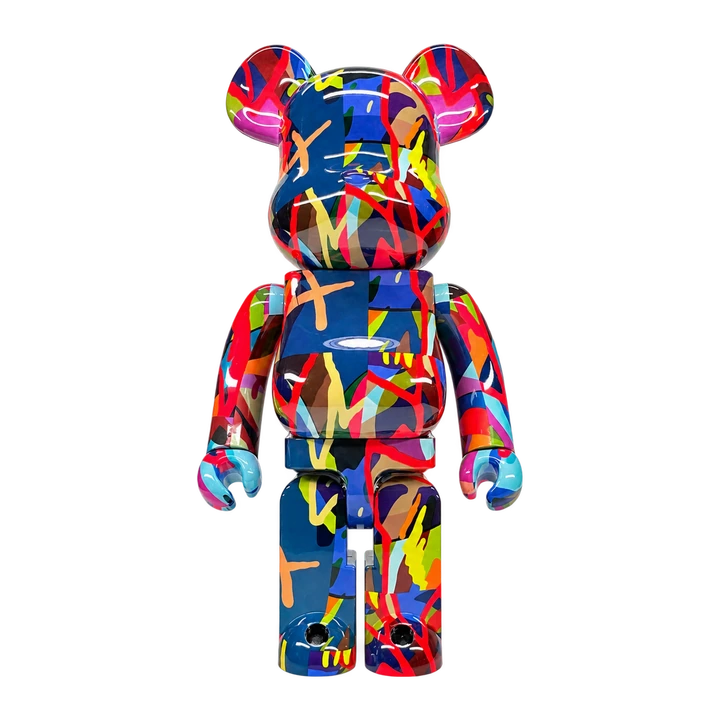
SNKRDUNK compares the TENSION 100% + 400% set (2021). Counterfeit markings can look crisper here; clarity alone proves little.
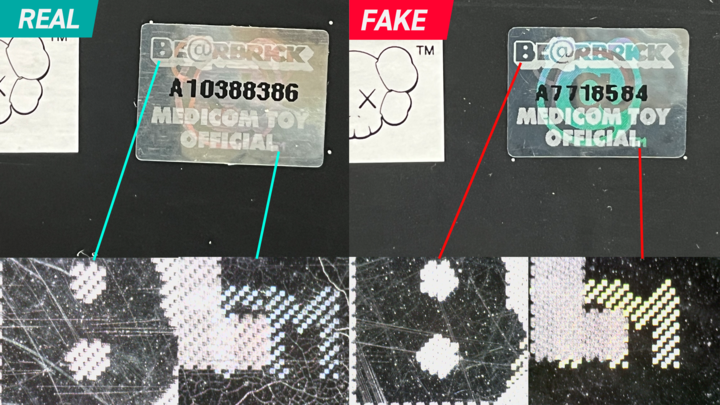
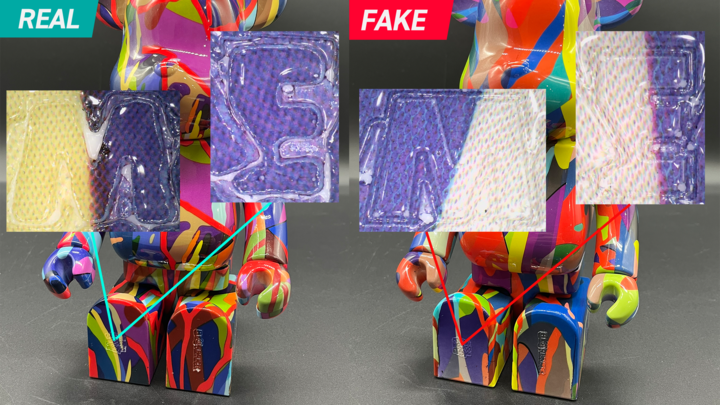
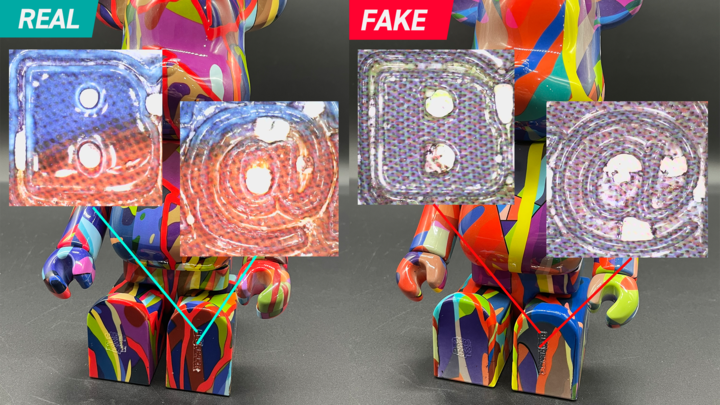
Which series are counterfeited most often?
We did not find reliable public figures measuring counterfeits by series. The BAPE × Mastermind, B@BY, MoMA and KAWS TENSION examples here are documented cases, rather than a league table of the most counterfeited BE@RBRICK releases. Popularity, age and high prices cannot by themselves establish the risk of a particular purchase.
Eye For Toys documented a chrome Garfield copy before release, comparing it with an exhibition prototype. Neither novelty nor a modest price guarantees authenticity.
What sole markings and a barcode actually establish
Ask for large, straight photographs of both soles, without glare. Compare the wording and placement with the same release; do not apply one edition’s typeface to every year. Seeing MEDICOM TOY is useful, but counterfeit makers can reproduce familiar letters too.
A similar principle applies to barcodes. GS1 explains that a GTIN identifies a product type, with the same number repeatedly printed on units of that product. Finding the correct listing can help check the name, colour and size. It does not establish the origin of the individual figure in front of you.
Investigate a conflicting result; no search result is not a conclusive verdict either. An ordinary web search is not a register of every package ever produced. GS1’s technical guidance on digital signatures treats protection against counterfeiting as a separate task. A product identifier is different from a system checking an individual item.
What to request before buying
Ask for a coherent set of fresh material: the figure from all sides, both soles, the entire box, labels, inner tray and any verification supported by the release. Ideally, the seller can show the figure and packaging in one continuous video. Catalogue photographs establish a reference; photographs of the actual item show what you are being offered.
Each photograph should make the relevant detail readable. For a stamp, request a separate picture in focus, rather than a magnified general view. For a disputed leg shape, ask for a profile, a front view and both feet standing on the same surface. Changing the light angle helps prevent reflections hiding printed boundaries. A few specific requests are more useful than a long exchange of “everything is genuine” assurances.
Ask where it was bought, whether a receipt survives, and whether it has been repaired, repainted or had parts replaced. Save the listing and correspondence before paying. A missing box limits the packaging checks; it does not automatically make a figure counterfeit. If a document describes a different edition or cannot be linked clearly to the object, ask another question.
Strongly distorted legs, mismatched contents and incorrect printing together are more persuasive than a single debatable reflection. With significant discrepancies, pause the purchase and consult someone familiar with the release. Our guides to BE@RBRICK sizes and KAWS collaborations can help identify the model first.
Look for a consistent account of the particular object, rather than a collection of secret tricks: which release it is, whether the figure matches, which protection system was intended and how it reached the seller. A convincing copy then has to withstand more than a familiar logo and a confident caption.
Further reading and catalogue
Compare formats in our BE@RBRICK 400% and 1000% categories. The catalogue includes a KAWS TENSION 1000% page; the microscope comparison above concerns the 100% + 400% set.