In this article
An artist recognised by his reflections
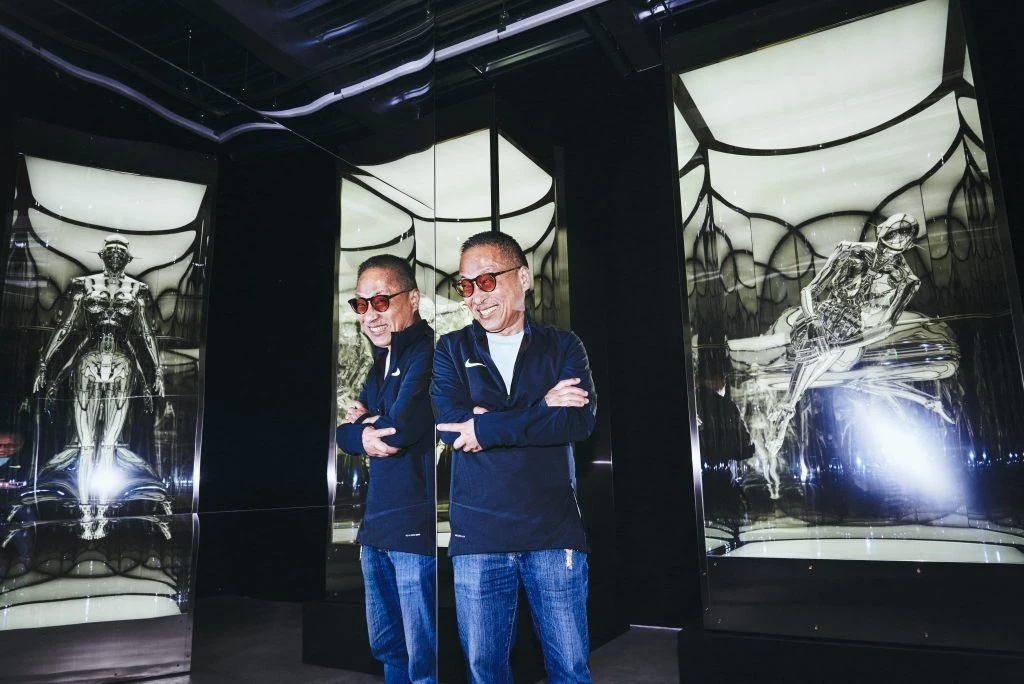
Hajime Sorayama was born in Ehime Prefecture, Japan, in 1947. His professional life began in advertising and illustration. That background matters: he learned to make images that convince the eye and remain in the memory almost immediately. Technical precision and expression work together in such images, rather than belonging to separate stages of the process.
Sorayama is best known for his feminine robots, but his world is considerably wider. It includes mechanical animals, dinosaurs, aircraft and imaginary machines. They share an attention to the outer shell. A surface reflects its surroundings, lets light through or suggests a complex mechanism inside. It rarely settles into an ordinary area of flat colour.
This visual language also travels comfortably between museums, music and object design. A small component, a large painting and a towering stage figure can inhabit the same imaginative world, even when their materials and the way audiences encounter them are very different. Recognising that continuity opens up more of his work than following a single famous character.
Why the robots emerged in the late 1970s
The early robot story is connected with an advertising commission for Suntory. In interviews, Sorayama recalled that Star Wars characters were initially discussed, but licensing considerations led to an original image. A commercial brief developed into a subject he would return to over many years.
Accounts differ slightly on the exact date of the first drawing. Biographies commonly give 1978, while some of the artist’s own recollections place it around the turn of the 1980s. The next major milestone is clearer: his book Sexy Robot appeared in 1983. Its title became associated with the series that brought him widespread recognition.
The fascination with metal had a longer history than that one commission. Sorayama has spoken about an interest in machinery and shiny surfaces stretching back to childhood. The robot brought together his professional technique, personal imagination and curiosity about the human body. That combination gave the image a life beyond the advertisement for which it had been conceived.
Pin-up, machinery and the image of desire
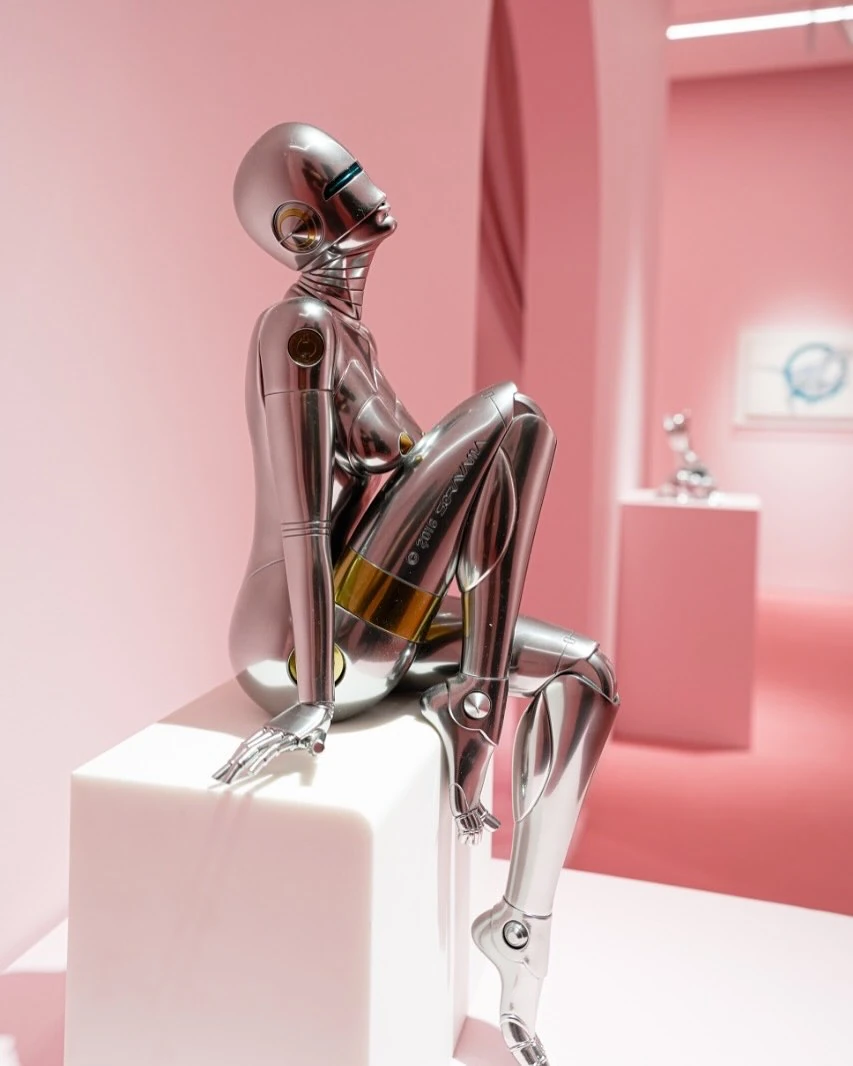
Sexy Robot carries traces of classic pin-up imagery: the position of the body, an arched back, expressive legs and a carefully composed gesture. Smooth shells, seams and mechanical joints occupy the places where we expect skin. Both visual languages remain present, and the image depends on the encounter between them.
That helps explain why Sorayama’s robot feels different from an ordinary machine. It has little need to demonstrate a practical function or explain how an engine works. The pose draws our attention. The mechanical body becomes a way of exploring beauty and attraction while keeping a distance between a real person and a fantasy of the human form.
The work leaves room for different responses. Viewers may admire its technical accomplishment, find humour or science fiction in it, or consider the bodies created by popular culture. Sensuality remains central to the technological image. A material associated with coldness enters a conversation about what we recognise as living and human.
Painting metal that is not there
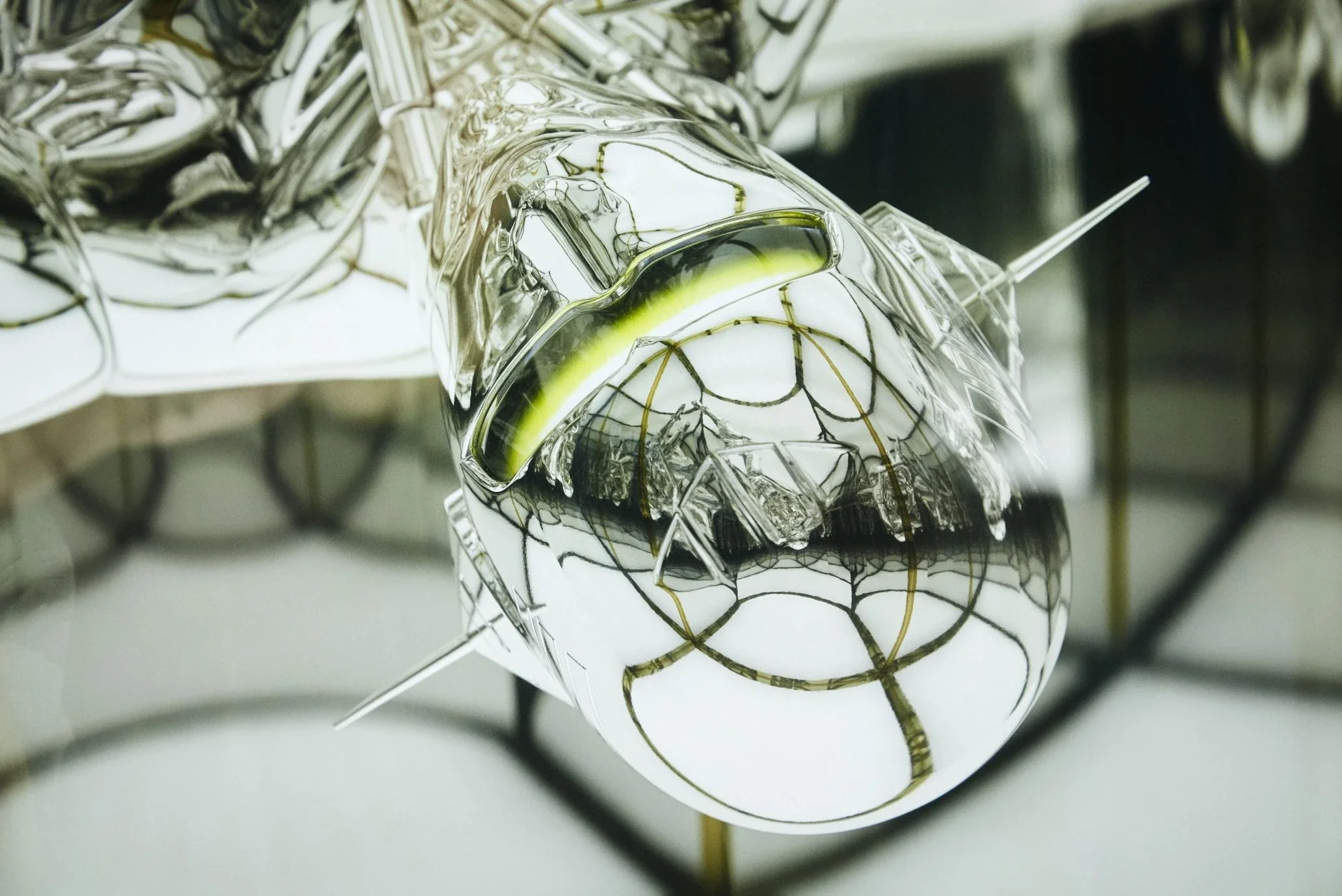
Sorayama’s hyperrealism is especially striking in two dimensions. There is no chrome shell on the paper or canvas, yet the eye reads one readily. A narrow bright strip describes a rounded edge; an almost black area suggests a deep reflection; a small tonal transition connects separate details into a continuous surface.
He has worked with airbrush techniques and developed extraordinary control over this visual language. Precision involves more than filling in a shape neatly. Reflections must follow its curves convincingly. Misplaced light would break the metal into unrelated patches; well-judged light gives an impossible body volume and an apparent weight.
Later exhibition works also use acrylic and digital printing on canvas. The description of an individual painting tells us how it was made, rather than assuming every work was completed entirely with an airbrush. Techniques can change while the underlying challenge remains familiar: arranging light so that the viewer believes in a surface.
There is a subtle shift when that surface becomes three-dimensional. A painted reflection is fixed by the artist. A mirror-like sculpture takes in the viewer and the room. Moving from an image to an object therefore changes more than size: the work begins to depend on the space in which it stands and the people who approach it.
From painting to reflection
From the drawn body to monumental sculpture
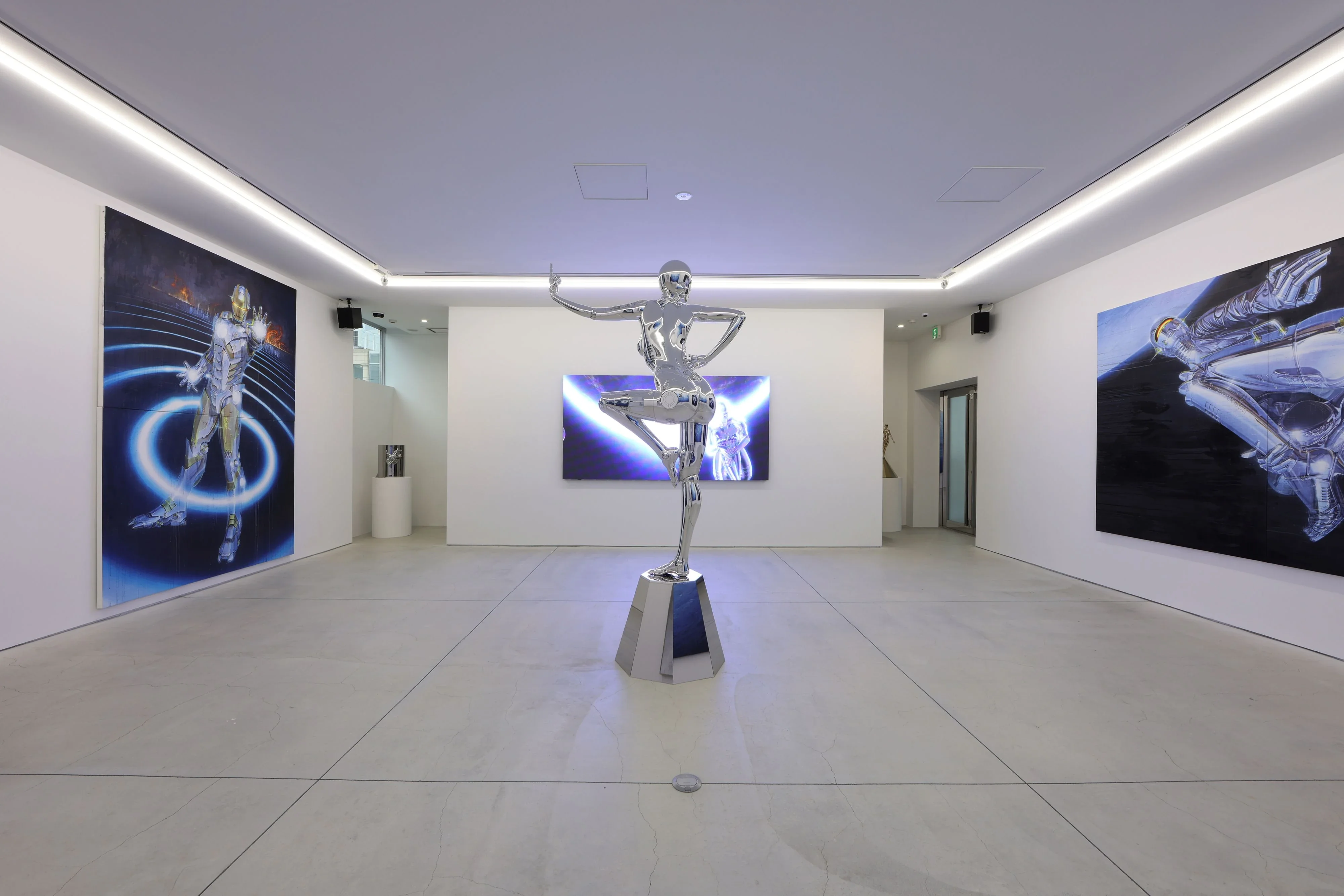
In three dimensions, Sexy Robot acquires a different presence. A viewer can walk around the figure, see the curve of its back and compare its proportions with their own body. A line that looked fluid in a reproduction becomes a form occupying actual space beside another person.
The material varies from work to work. Catalogues record aluminium, bronze, fibreglass, resins, steel, coatings and lighting elements. A reflective finish may cover a relatively lightweight structure, while another sculpture uses metal as its body material. A silver appearance is the beginning of the description, rather than a complete account of how the object was made.
Hands, feet and mechanical joints become particularly noticeable at a large scale. They hold a balance between body and construction. One figure sits, another seems suspended, another takes a step. The sculptures can remain still while their poses encourage us to search for a point of support and imagine the movement continuing.
They also ask something of their surroundings. Space in front of a figure makes its outline legible, and a side view reveals how the pose works. Photographs with people help recover proportions that are easily lost in an isolated catalogue image. The familiar shape becomes a physical encounter again.
Dior and Kim Jones: a robot at the centre of the show
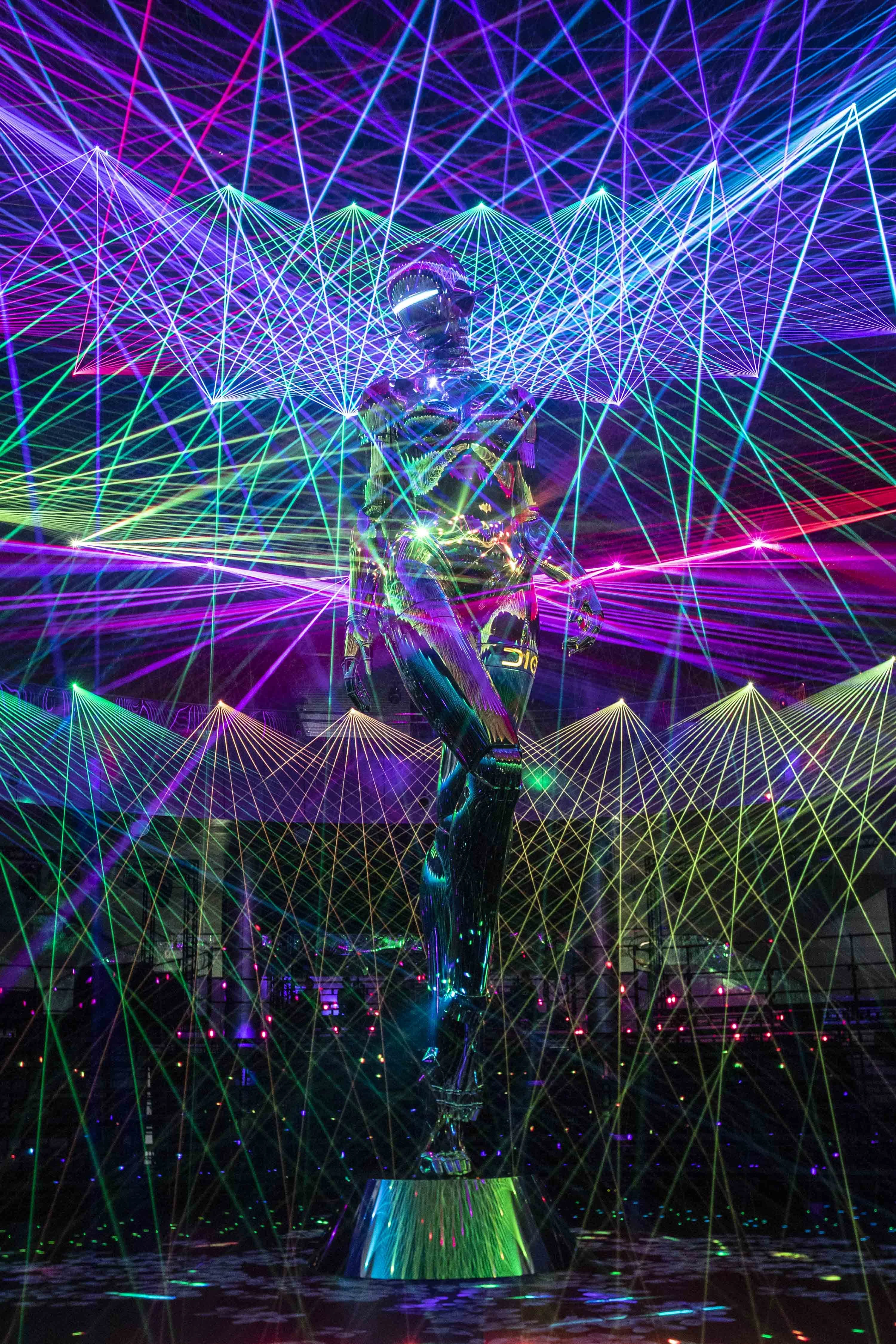
Kim Jones’s Dior Men Pre-Fall 2019 show took place in Tokyo on 30 November 2018. A huge robotic female figure by Sorayama stood at the centre of the space as models walked around it. The collection’s season belongs to 2019, while the show itself happened at the end of the preceding year.
For the audience, the robot became almost architectural. Rising far above human scale, it was connected to the runway through lighting and laser beams. Reports commonly describe it as approximately twelve metres tall. It changed the character of the entire venue: the clothes appeared within a world shaped by the artist.
The making-of footage gives another perspective on that spectacular surface. It shows a carved polystyrene structure being finished with aluminium paint. At this size, the construction and coating served the setting of the show, creating a particular presence within the room. The impression of a gigantic metallic body came from a carefully made stage object.
The collaboration also entered the collection itself. Robots, dinosaurs, floral motifs and a reworked logo appeared on clothing and accessories. Sorayama’s contribution extended into the atmosphere of the clothes, beyond the use of one illustration as a print. Reflective imagery and the lightness of fabric became parts of the same presentation.
Dior Metal Saddle: a bag as sculpture
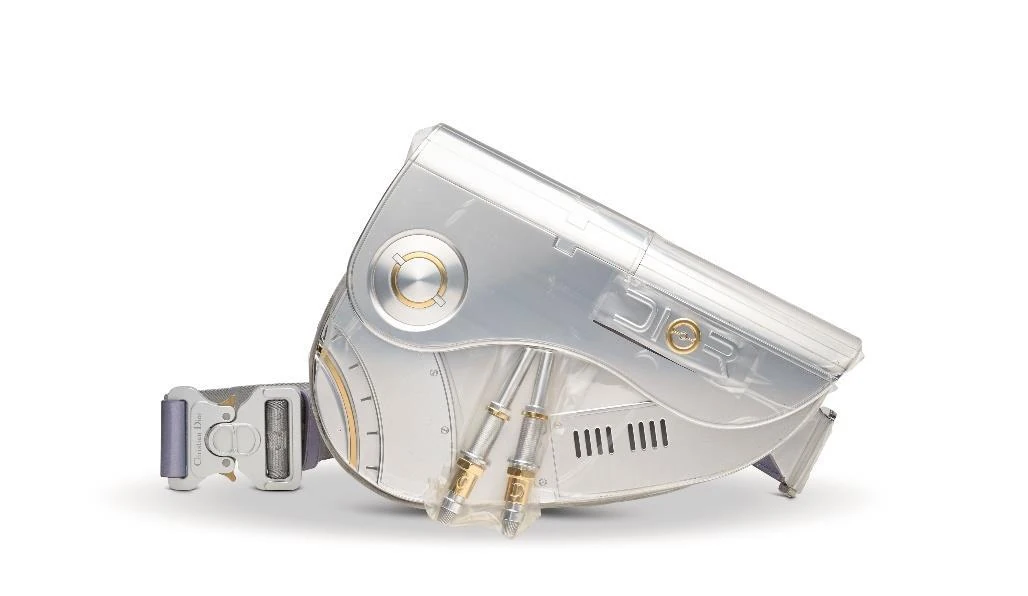
The 2019 collection also introduced a metal version of the Saddle. Its familiar shape acquired a technical shell, silver and gold details and visible fastenings. Sotheby’s connects one documented example with the show’s fourth look and describes a black leather lining.
It is an intriguing turn in Sorayama’s work: the shell now belongs to an everyday object rather than an imaginary body. The bag keeps its recognisable outline while beginning to resemble part of a robotic suit. It can be read as an accessory and as a small sculptural object at the same time.
Both the overall silhouette and the close details invite attention: the curve of the body, its connections and the contrast between a rigid surface and a soft interior. It encourages the same movement around the object as a sculpture. In someone’s hands or on a plinth, it takes on a different presence. Its function remains, while becoming one of several ways to experience it.
Sexy Robot from the runway to the gallery
The name Sexy Robot covers distinct works. Dior’s enormous runway figure, the more compact Sorayama × Dior Sexy Robot walking and Life Size Seating Model B each have their own construction and history. Their shared imagery can obscure those differences in a small photograph.
CICA Vancouver’s official worklist records the 2019 Dior Sexy Robot walking as 285 centimetres tall, made with fibre-reinforced plastic, silver plating and LEDs. This is an individual exhibition sculpture. Its description tells a different production story from the giant scenic figure made for the Tokyo show.
A documented edition of three belongs, for example, to the 2017 Sexy Robot, Life Size Seating Model B: Christie’s catalogued the example it sold as number 1/3. Other works have other editions. Almine Rech’s worklist records three examples plus two artist’s proofs for the 2021 Floating Bronze, and fifteen for Type II Floating.
Rarity becomes more meaningful with a full title attached. Year, material, dimensions, number and the presence of artist’s proofs all contribute to the identity of a sculpture. They allow us to appreciate the particular object and understand the basis of an edition claim without applying it to every robot the artist has made.
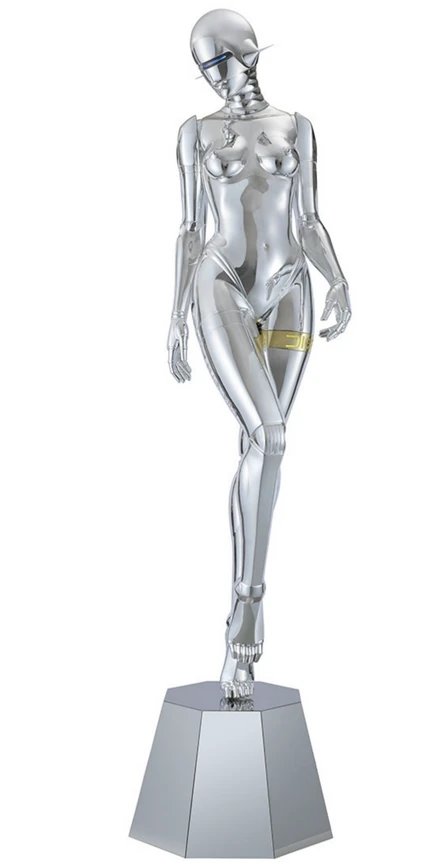
The seated Sexy Robot at Christie’s
On 2 December 2021, Christie’s in Hong Kong sold Sexy Robot, Life Size Seating Model B for HK$5,750,000 including the buyer’s premium. The catalogue records a 2017 work, numbered 1/3 and standing 163 centimetres high. It is a notable documented result for one of the artist’s large sculptures.
Silver and gold surfaces meet in an expressive seated pose. The material description includes fibreglass, iron, coatings, airbrush colouring and light. The auction result belongs to this example, with its particular history and specification. It gives us a concrete object to consider alongside the image we recognise.
The result was equivalent to approximately US$738,000.
The significance also extends beyond the sum. A particular large sculpture was acquired publicly as a work of art in its own right. Pose, scale, material, provenance and edition help explain what was being offered. Those are the same qualities that reward close attention before we even reach the price.
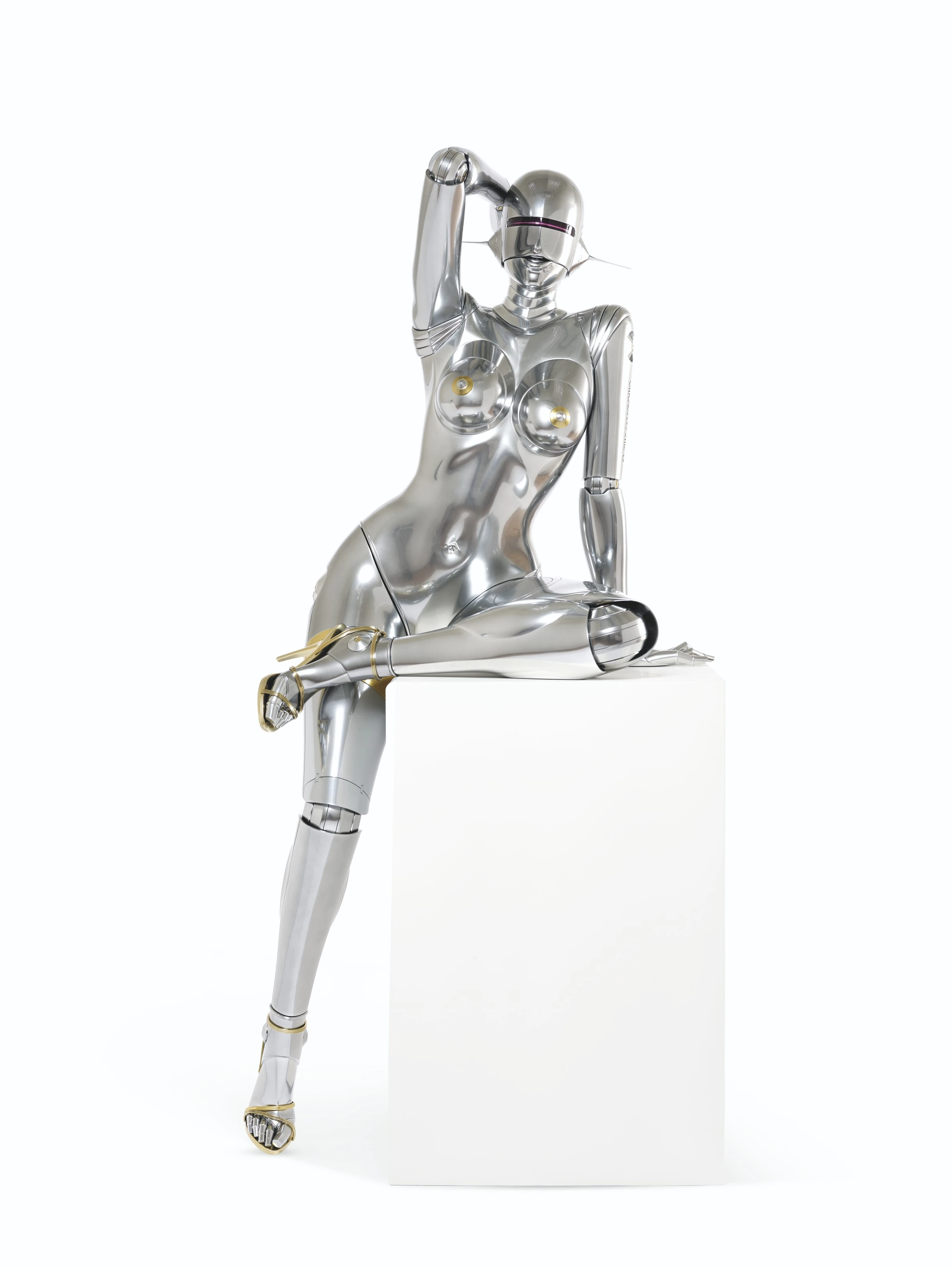
Floating bodies, bronze and illuminated spaces
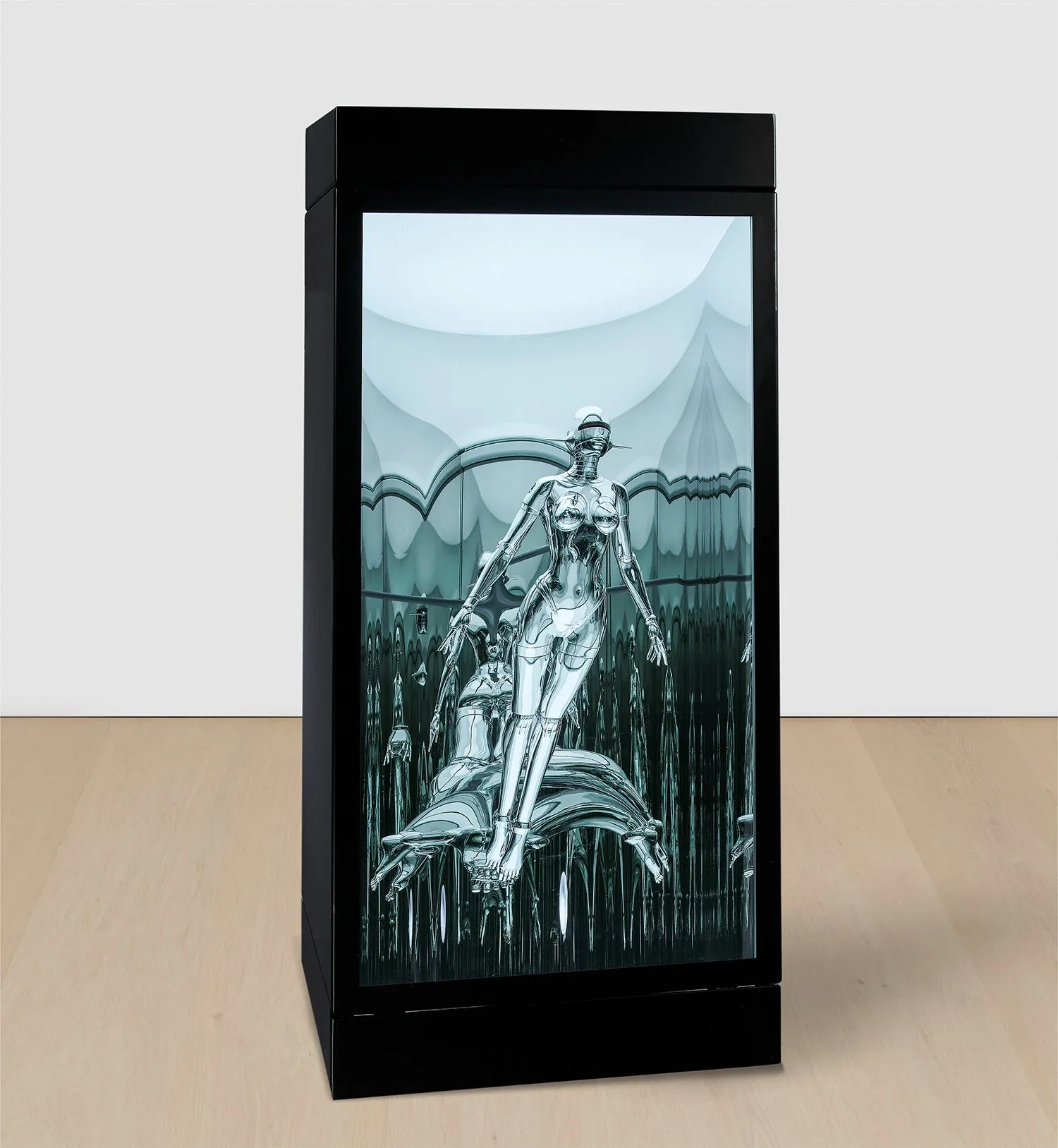
The Floating works seem to release the body from its ordinary weight. A figure stretches out, its support concealed or incorporated into the composition, and the reflective surface adds to the sense of unreality. In illuminated versions, the sculpture interacts with a light-filled setting of its own as well as the light around it.
At Phillips on 12 December 2025, Untitled_Sexy Robot type II floating, a 2022 work numbered 4/15 and measuring 270 centimetres high, achieved HK$2,064,000 including the buyer’s premium. The description lists resin, Plexiglas, silver plating, LEDs and steel elements. Its dimensions and spatial construction distinguish it from smaller collectible versions.
Another work, Sexy Robot Infinity — 1/3 Scale from 2020, sold at Phillips on 1 June 2024 for HK$1,016,000 including the buyer’s premium. It is 109 centimetres high and numbered 12/25. Its construction brings together aluminium, resin, steel, acrylic and lighting elements.
These results describe different works and different artistic solutions. Pose, dimensions, edition, materials and the role of light all change. Even a scale designation such as 1/3 needs to be read alongside the actual measurements. One sculpture may be organised very differently from another carrying a related name.
Two large Floating sculptures
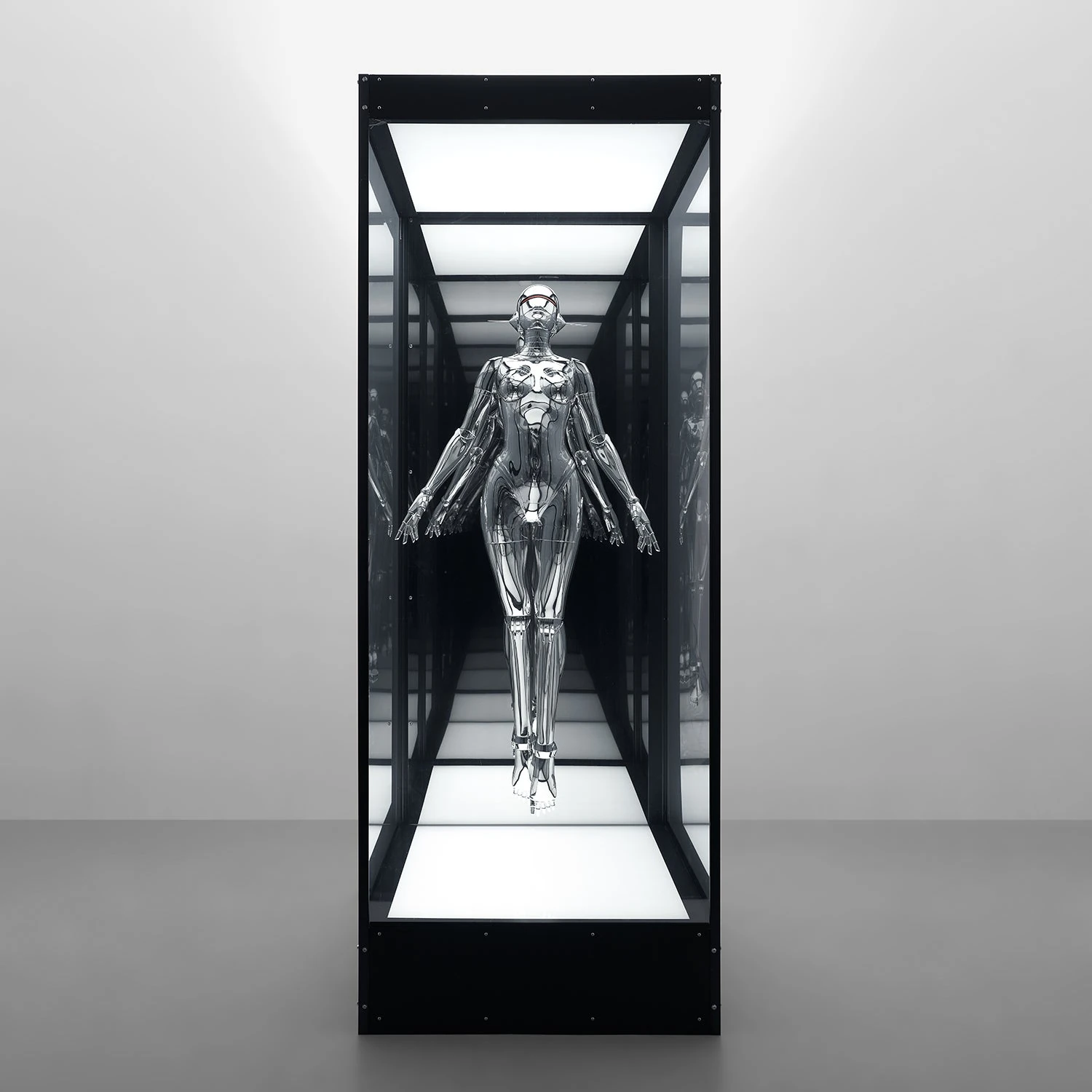
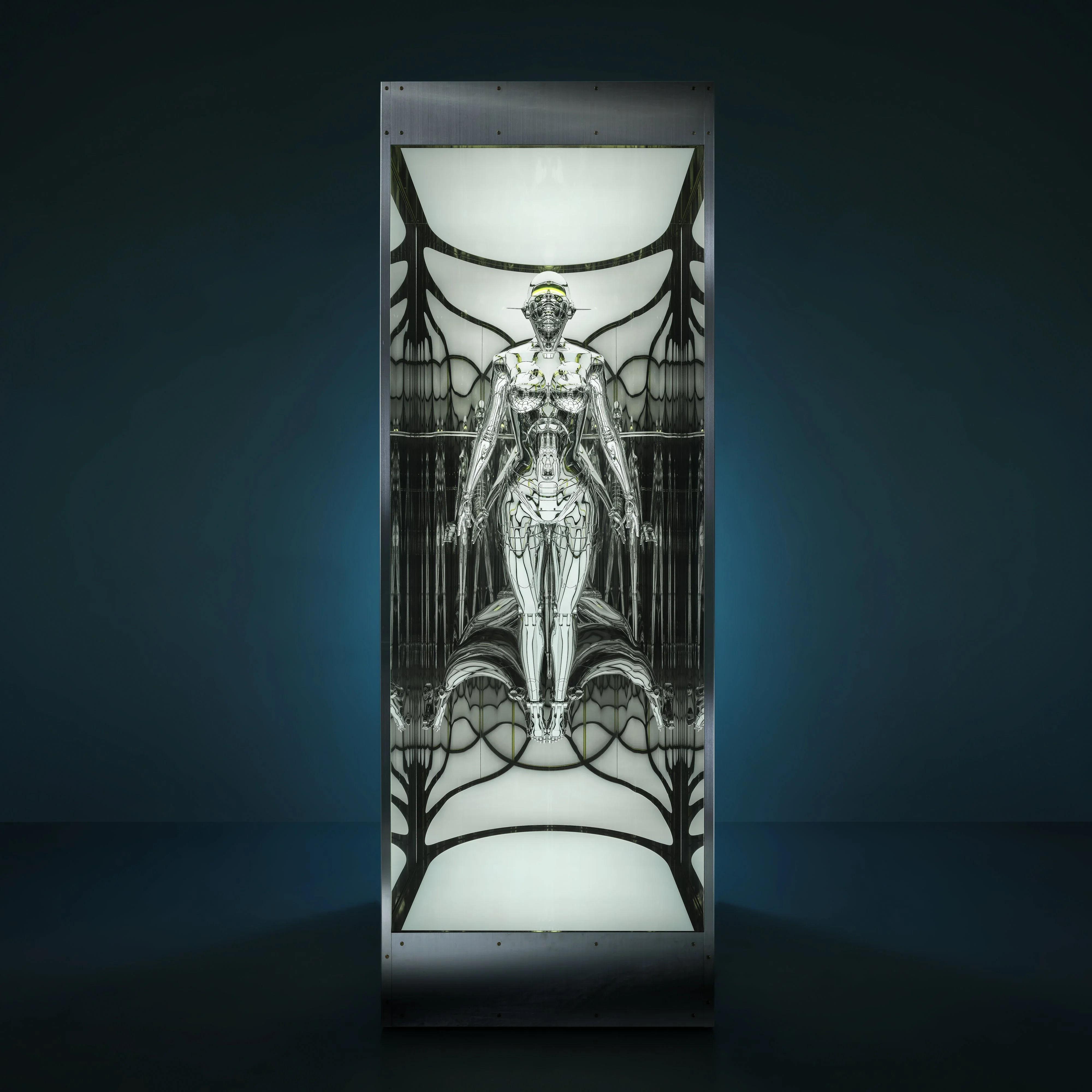
Large sculptures at auction
Four sales reveal the variety within the larger Sexy Robot works. Each result belongs to the specified example, with its own dimensions, edition and construction.
| Work and example | Auction and date | Result |
|---|---|---|
| Sexy Robot, Life Size Seating Model B 2017 · 163 cm · 1/3 | Christie’s · 02.12.2021 | HK$5 750 000 |
| Sexy Robot_Floating 2019 · 270 cm · 12/15 | Phillips · 30.11.2022 | HK$2 268 000 |
| Untitled_Sexy Robot type II floating 2022 · 270 cm · 4/15 | Phillips · 12.12.2025 | HK$2 064 000 |
| Sexy Robot Infinity — 1/3 Scale 2020 · 109 cm · 12/25 | Phillips · 01.06.2024 | HK$1 016 000 |
Results include the buyer’s premium and are stated in Hong Kong dollars.
These sales connect collecting interest with individual works. A seated robot, a floating figure in a light-filled enclosure and the Infinity sculpture offer different experiences: pose, viewing distance and the role of light all shape the encounter.
The smaller Floating editions
Sorayama also makes smaller editioned sculptures that bring this imagery into domestic space. They retain the pose, light and reflections in a format that can be encountered close up. Their own production histories help explain where they sit alongside large gallery works.
For the 2020 Sexy Robot Floating 1/4 scale, Phillips describes a height of approximately 55 centimetres and an example from an edition of 1,000. Its listed materials include PVC, ABS, alloy, silver plating and LEDs. A separate catalogue entry records gold-plated resin, PVC and an edition of 500 for a gold-coloured version.
A scale designation also tells a different story from an edition number. “1/3 Scale” describes proportions, while “1/3” in an edition field identifies one example out of three. Christie’s records a 2016 Sexy Robot 1/3 Scale Aluminum A numbered 4/10: its title and edition describe two separate aspects of the work.
These are editions in their own right, separate from the seated sculpture numbered out of three. The character provides an artistic relationship, while rarity and production need to be understood for each release. The smaller objects have their own techniques and reasons for being made.
Their scale also invites a different kind of relationship. A figure can become part of everyday surroundings: its illumination changes the feeling of a shelf in the evening, and daylight brings the window and nearby objects into its reflections. A collectible object can sustain interest through these small changes long after the initial encounter.
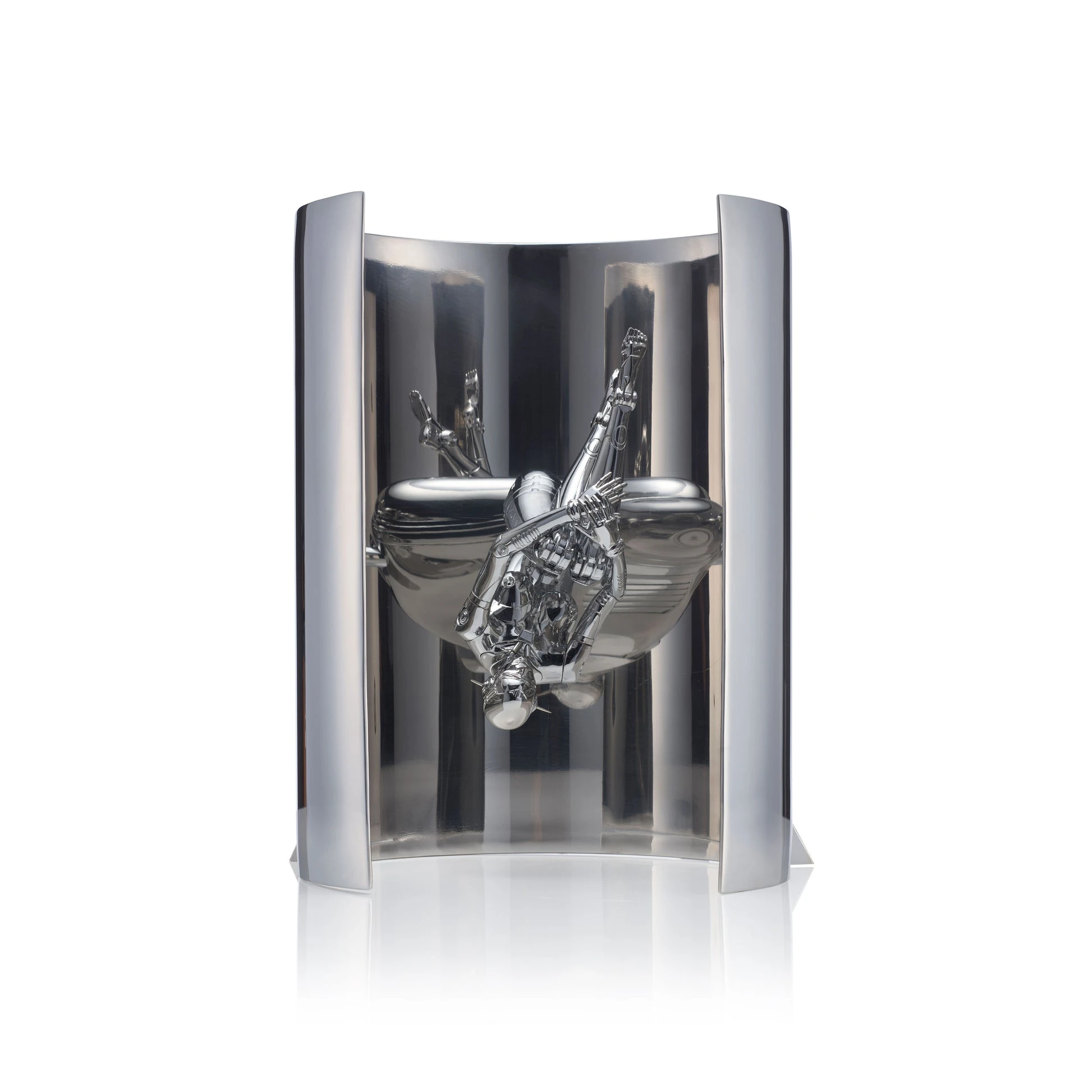
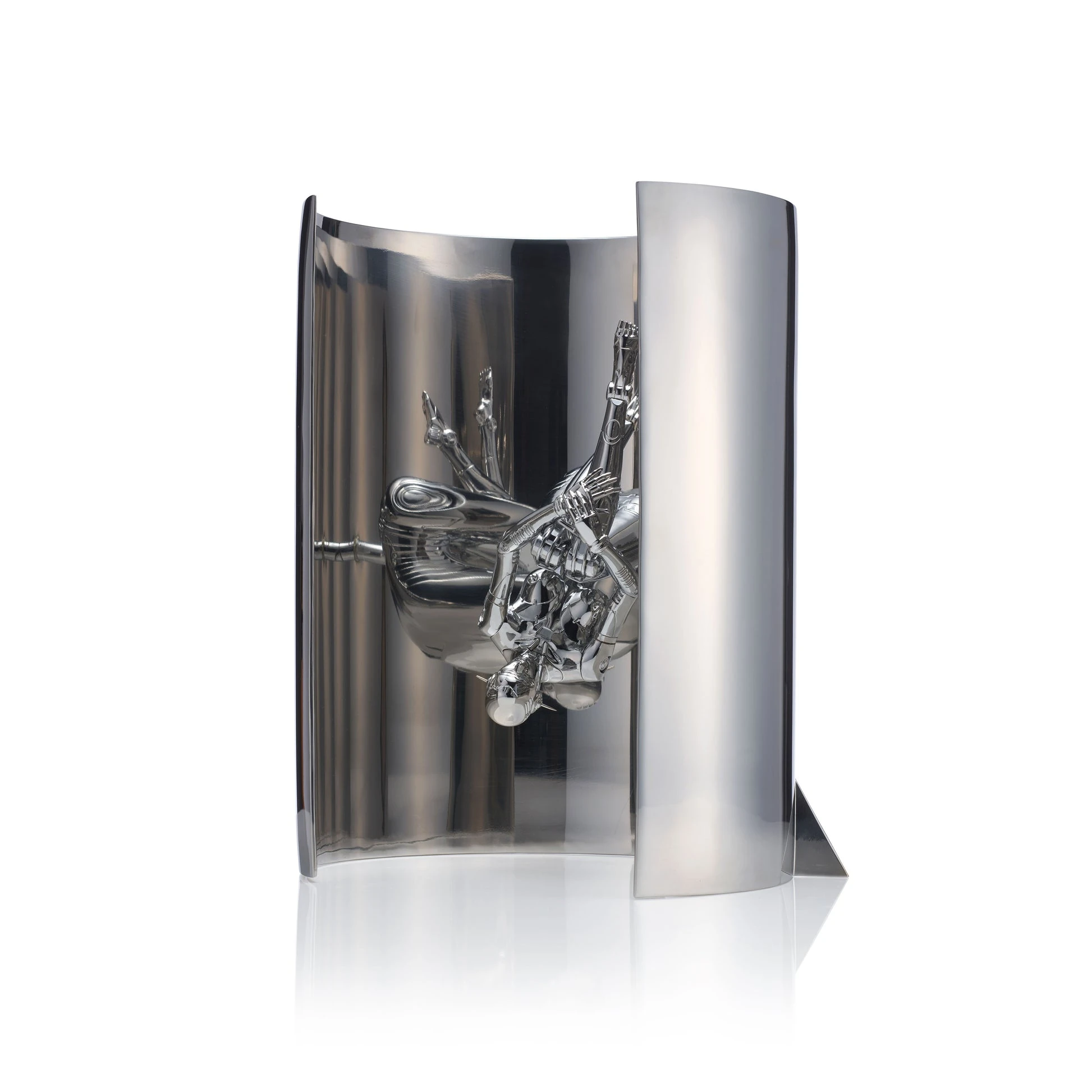
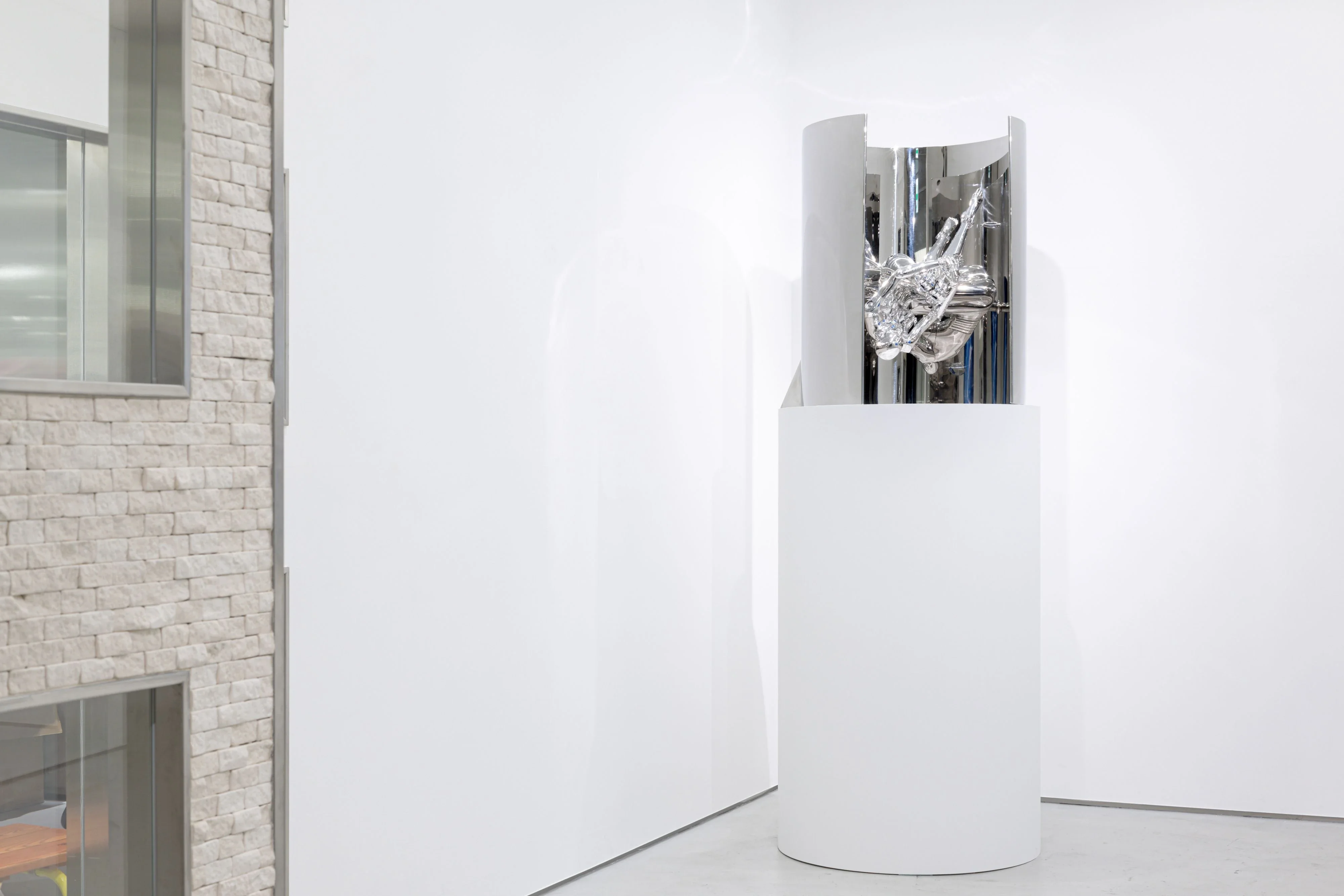
Another distinct release is the 2023 Sexy Robot_Space Traveler 1/6 scale, listed by NANZUKA in an edition of 100. Its figure sits inside a mirrored enclosure: the collectible includes a small reflective environment of its own. The photographs show both the object and its placement in an exhibition.
Space Traveler: collectible and gallery setting
KAWS and No Future Companion
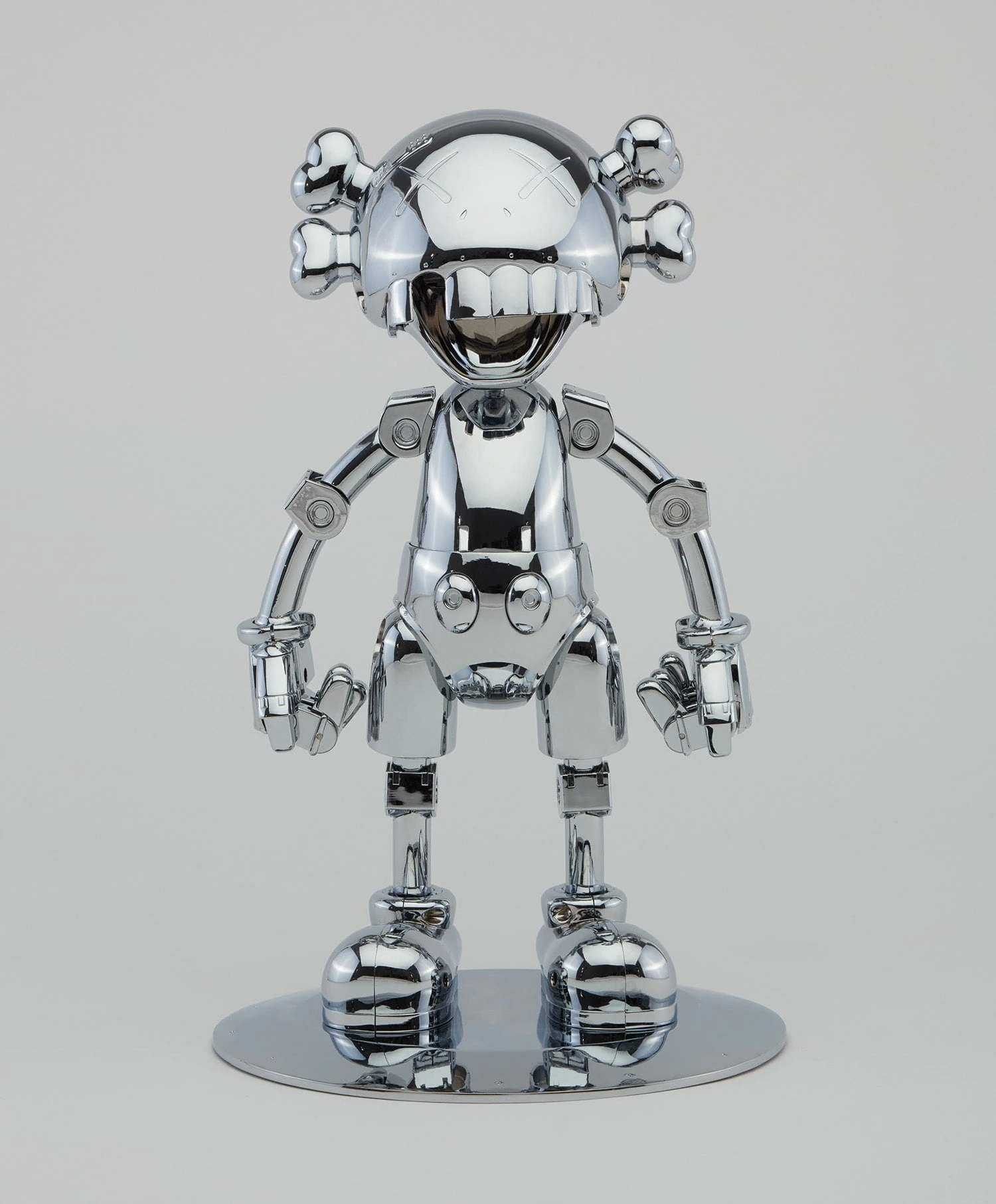
The collaboration with KAWS shows Sorayama working with another artist’s already recognisable character. No Future Companion from 2008 retains COMPANION’s distinctive head and body while introducing a mechanical shell and a reflective surface.
Auction catalogues document silver and Black Chrome versions, numbered examples from editions of 500 and a height of approximately 32 centimetres. Sotheby’s explicitly describes metallised plastic for Black Chrome. The description gives useful substance to an appearance that the eye might simply read as metal.
Released by MEDICOM TOY and OriginalFake, this is a separate collectible object with its own form and history, distinct from BE@RBRICK. Beside a conventional COMPANION, the change in character becomes particularly visible. Familiar human awkwardness meets the apparent precision of a machine.
Both artists’ visual languages remain present. That coexistence explains why the collaboration holds more interest than a change of colour alone. It also helps show how Sorayama found a place within art-toy culture while retaining the particular qualities of his own work.
The Weeknd: from image to stadium stage
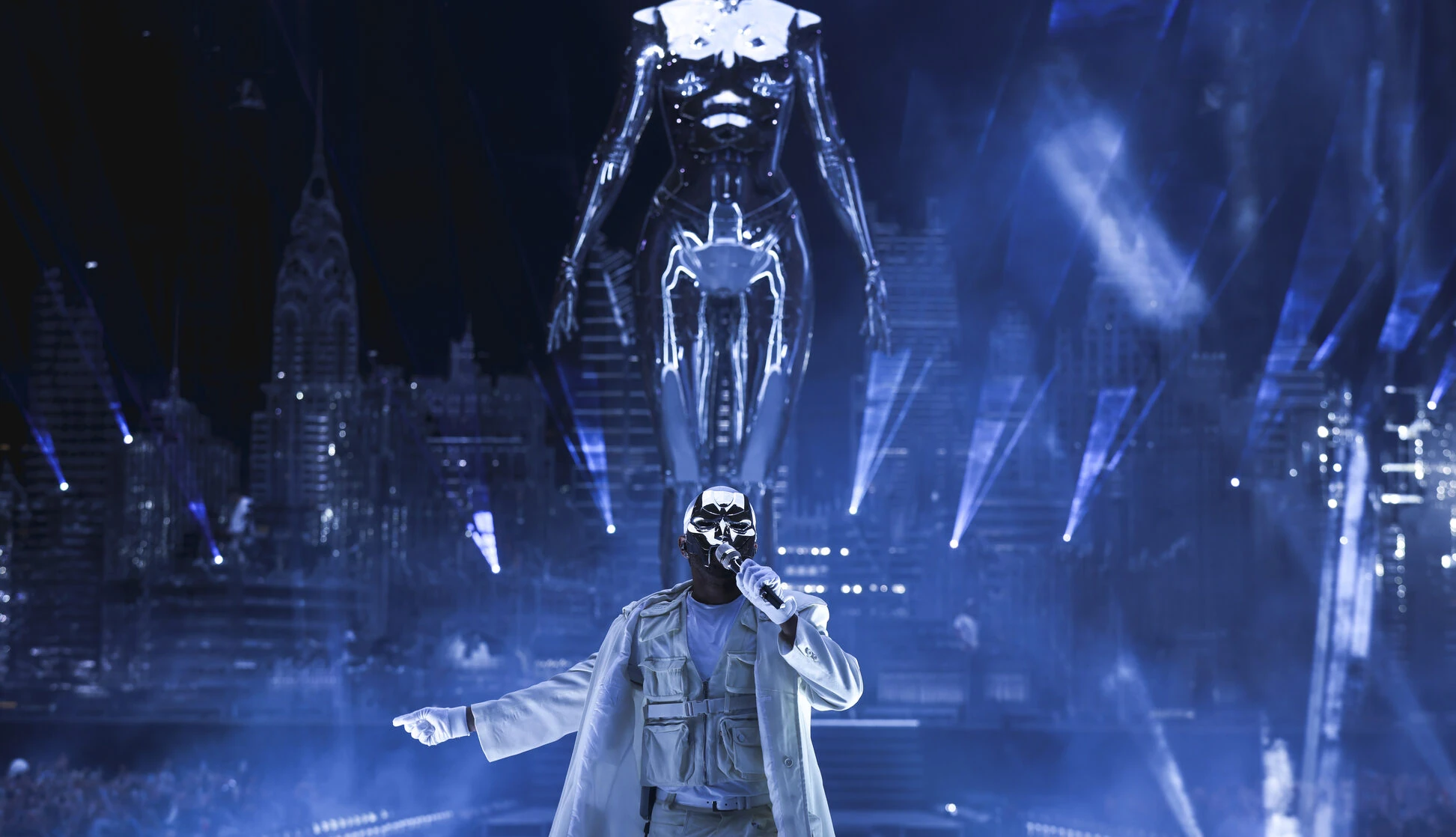
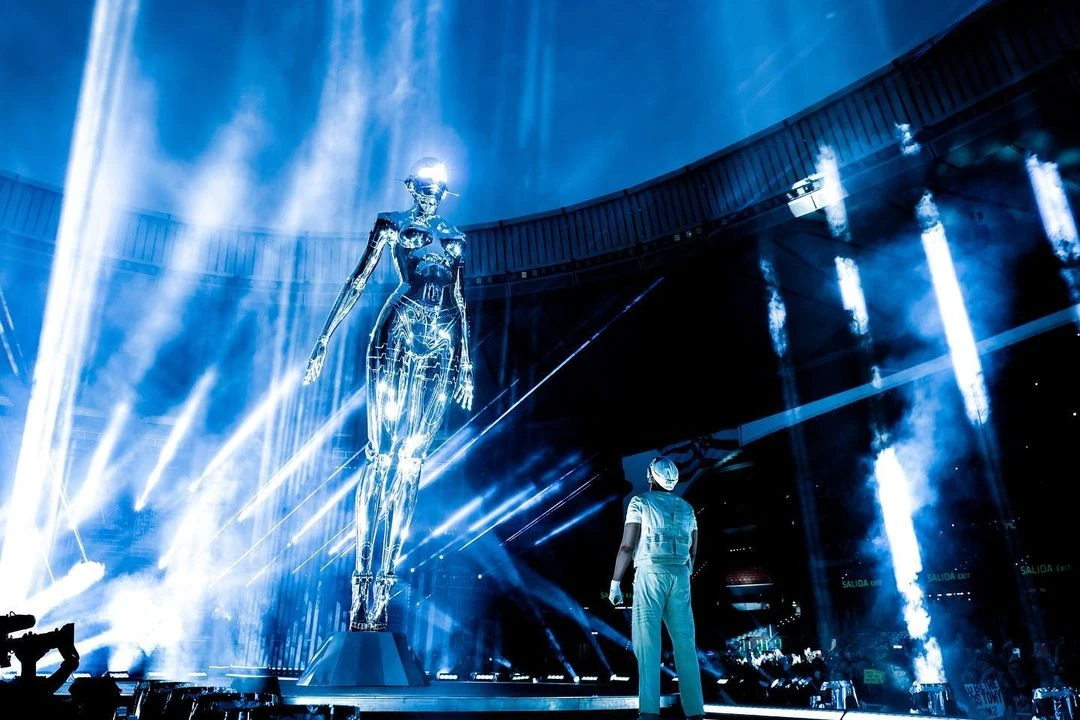
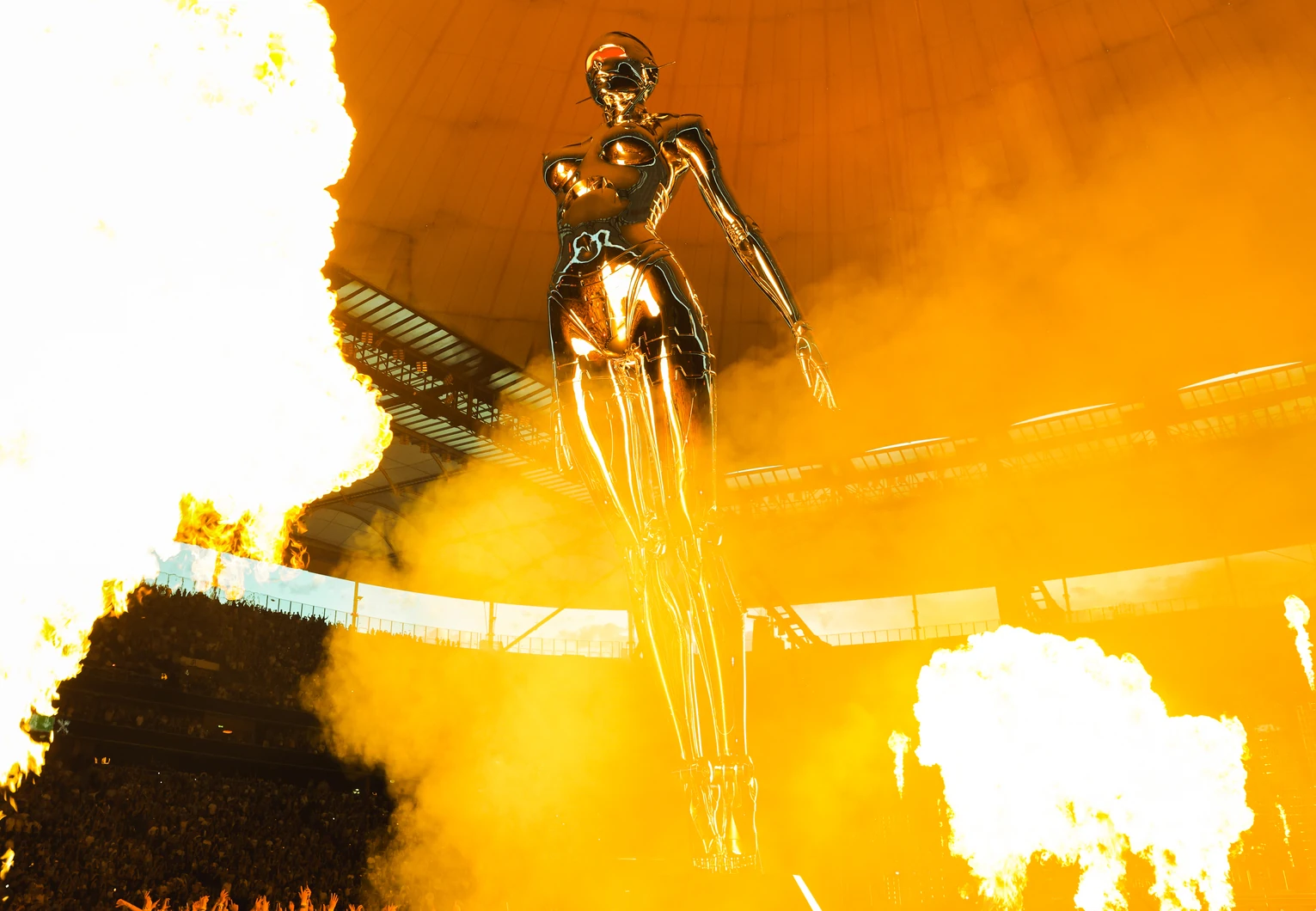
Music brought Sorayama’s imagery to another audience. After the 2001 cover for Aerosmith’s Just Push Play, his robotic world continued to appear alongside artists of new generations. The Weeknd collaboration makes the transition from an image to an enormous stage figure especially clear.
From 2023, Sexy Robot formed part of the visual setting for the After Hours Til Dawn tour. A stadium changes how a sculpture is read. Screens can reveal detail, while from the back of the venue the silhouette matters first. The figure shares its setting with stage architecture, lighting and thousands of people.
The 2026 projects introduced an even larger gold-coloured figure. A monumental stage work has a different purpose and production history from a small collectible sculpture or souvenir, even when related imagery connects them. Scale becomes part of how the image communicates with its audience.
In a musical setting, the robot can feel like an observer, an imaginary creature or a cool reflection of human emotion. These are possible readings rather than a prescribed storyline. Sorayama provides a recognisable form that can hold its place within the atmosphere of a performance, without a lengthy explanation between songs.
Robots on The Weeknd’s stage
Future Mickey and unexpected objects
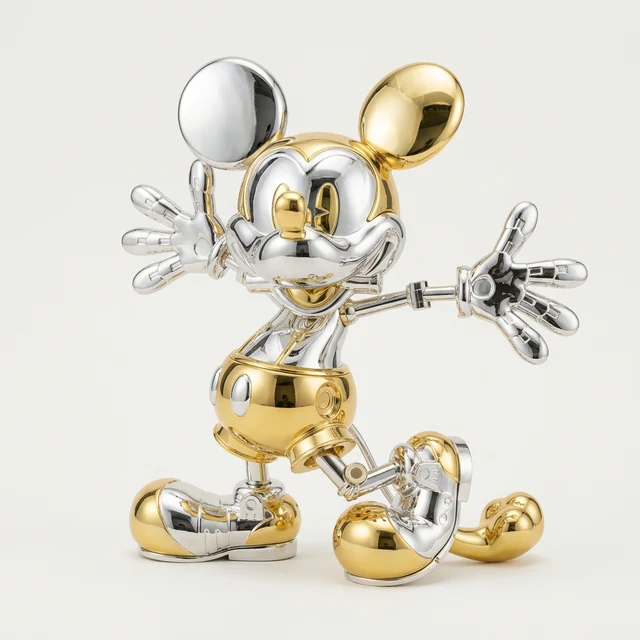
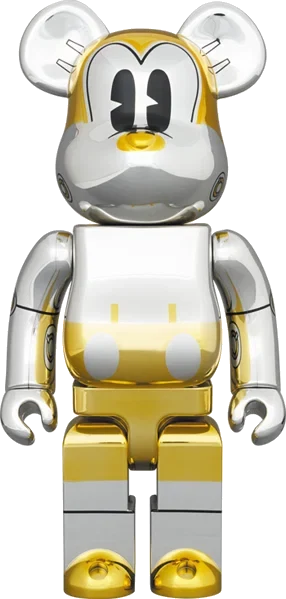
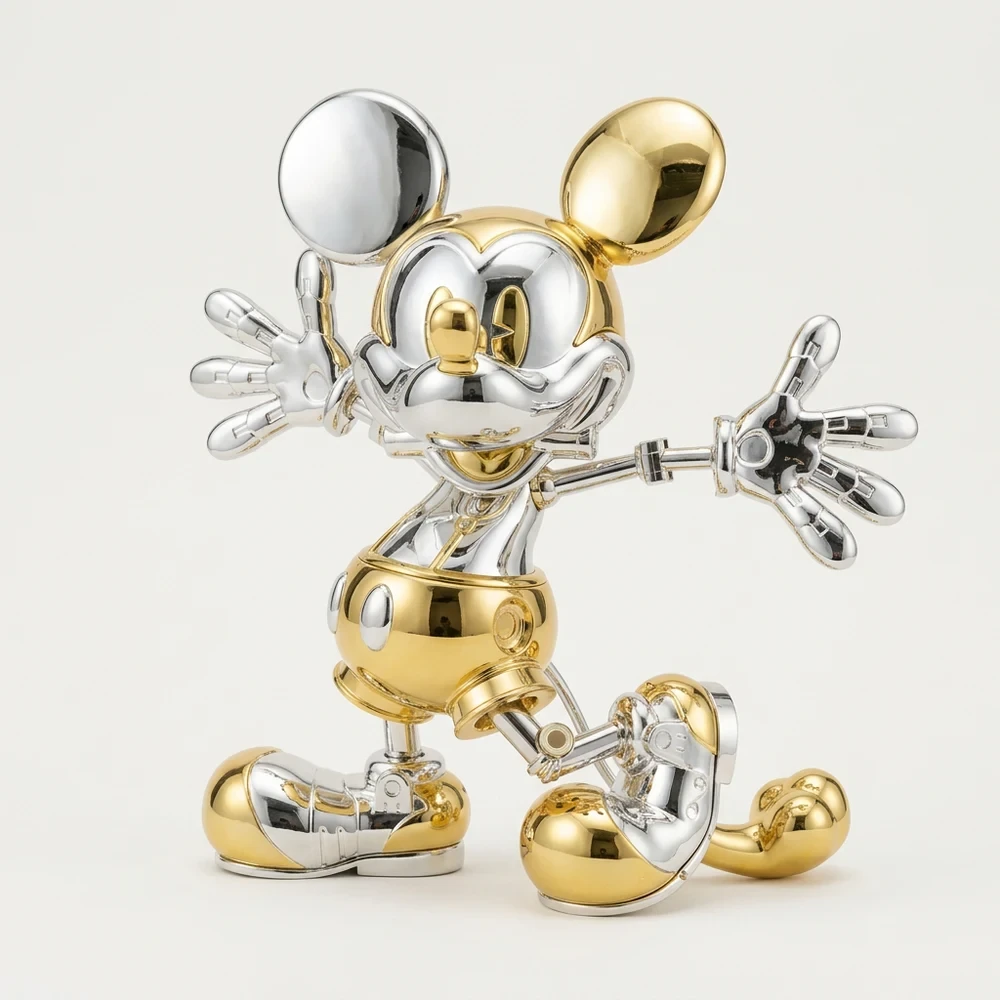
Sorayama’s visual language also works with more approachable characters. Future Mickey developed from his reimagining of Mickey Mouse. The TOMY collaboration began in 2003, followed by further versions and a Disney centenary model in 2023. The ears and smile remain, while the body takes on the appearance of a fantastic mechanism.
The Midas Touch, published by Case Studyo in 2019, has a different mood. This gold-coloured hand makes a provocative gesture. The publisher specifies gold-plated porcelain, a height of 33 centimetres and an edition of 100 plus ten artist’s proofs. A fragment of a body is enough to carry Sorayama’s character.
Its predecessor, A Touch of Mercury from 2018, used titanium-plated porcelain. Here the material description is particularly revealing. The silver effect is created on ceramic; the title suggests an image rather than naming the substance from which the object is made.
Such small works reveal the range of Sorayama’s practice more vividly than a long list of brands. One keeps the identity of a famous character; another builds an entire statement around a hand gesture. Surface, humour and a slightly unsettling boundary between the human and the mechanical connect them.
The separate photograph from our catalogue shows Mickey Mouse NOW AND FUTURE, another sculptural interpretation of Mickey, with open hands and mechanical joints.
Mechanical animals and AIRSORAYAMA aircraft
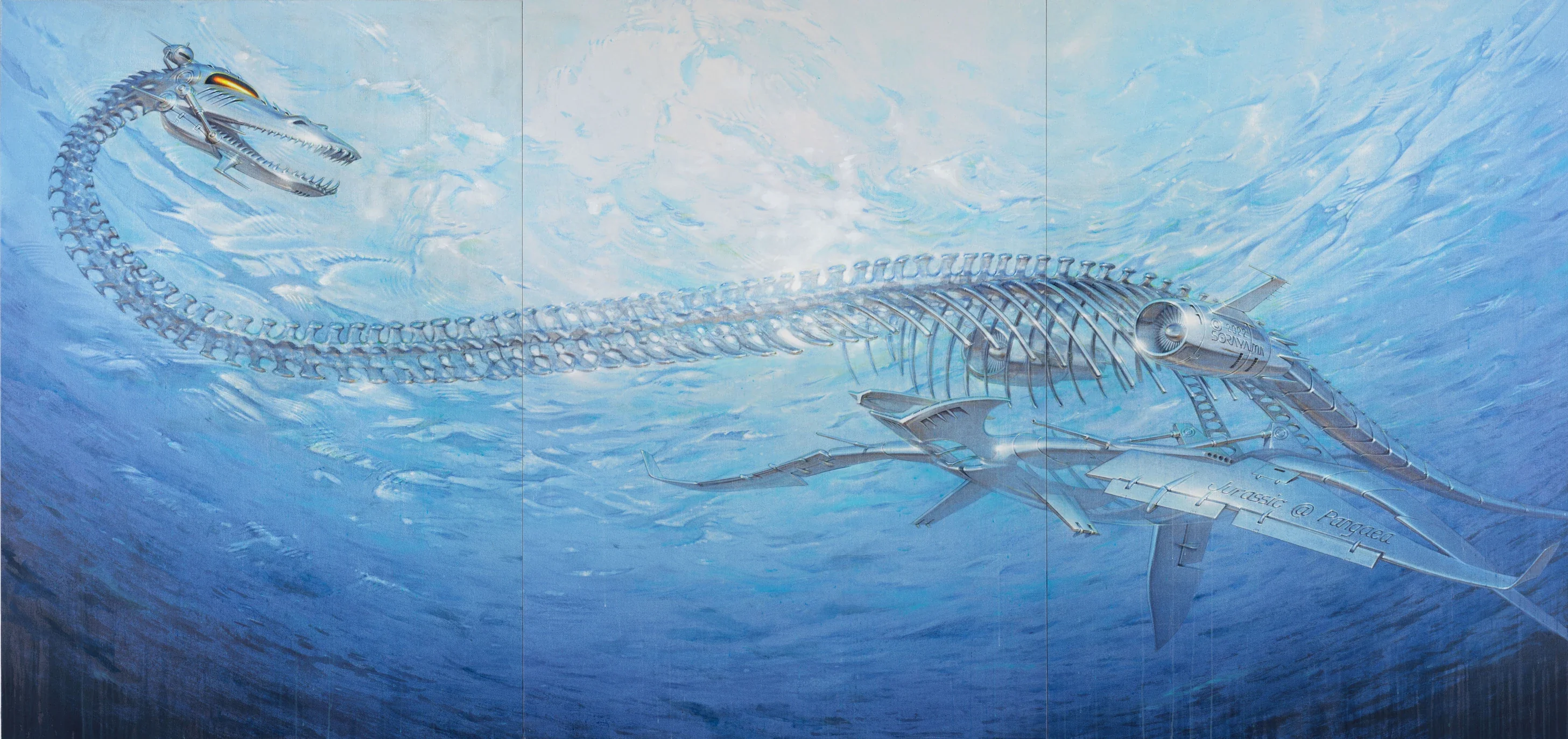
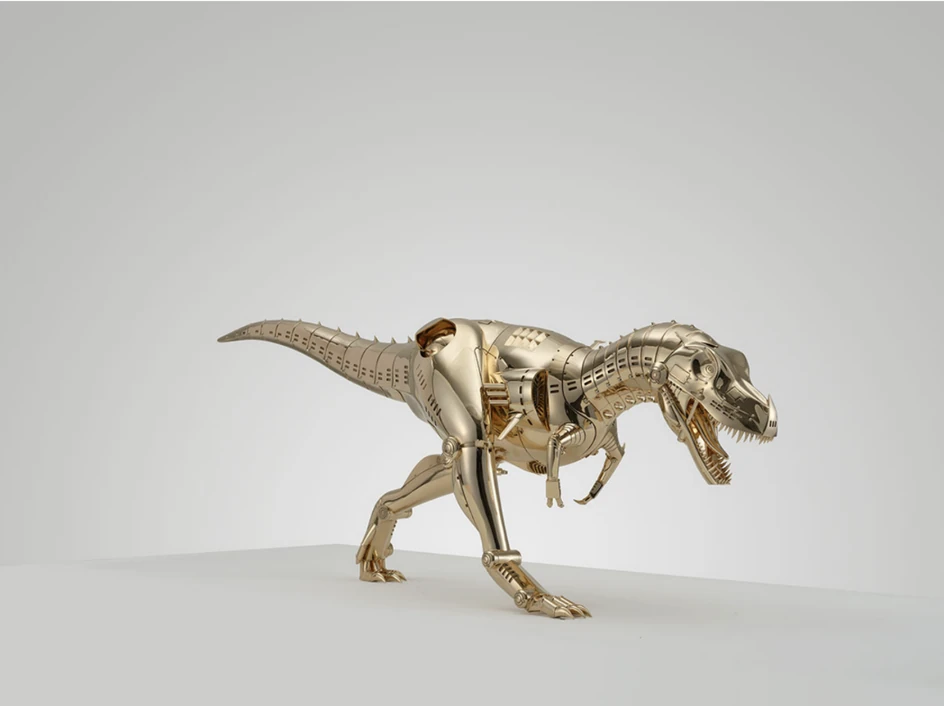
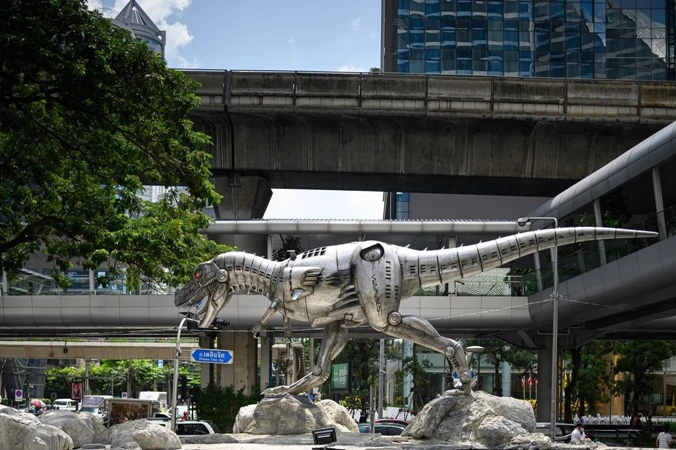
Dinosaurs and sharks introduce a different sense of movement. Instead of a human pose, they offer tails, teeth, ribs and a streamlined outline. A metallic shell transforms a familiar animal into something that can resemble both a museum skeleton and a machine still waiting to be built.
The material again belongs to the individual sculpture. Phillips documents the 2019 T-Rex Silver as aluminium and stainless steel, in an edition of five plus two artist’s proofs. Those particulars distinguish the work from other dinosaur figures, even where related imagery makes them look similar at first.
In 2026, Sorayama’s practice extended far beyond the gallery when STARLUX presented AIRSORAYAMA: silver and gold liveries for two Airbus A350-1000 aircraft. This was an intriguing continuation of his long-standing interest in flying machines. The image became attached to an actual aircraft designed to carry people.
The airline describes special shades developed with Airbus and MANKIEWICZ, using mica particles and a layered paint application. The effect of liquid metal was achieved within the operating requirements of a contemporary aircraft. Technical constraints became part of the creative brief, shaping how Sorayama’s familiar shine could appear on a working machine.
The dinosaur as sculpture and city landmark
AIBO: a machine that responds
The original Sony AIBO from 1999 has a particular place in this history. MoMA’s collection page credits Hajime Sorayama together with Sony Corporation. The museum record identifies a specific work of industrial design, providing a concrete connection between his practice and the collection.
AIBO did more than resemble a living creature. It responded to touch and sound, moved and gave the impression of interaction. Where a static Sexy Robot conveys emotion through a pose, this device could create an emotional relationship through its behaviour.
That makes the collaboration important to understanding Sorayama’s wider work. In his drawings, metal takes on a human gesture; in AIBO, a mechanical body enters an everyday relationship with its owner. The boundary between fantasy and design shifts, while a related question remains: why are we so willing to recognise character and life in an artificially created form?
Exhibitions that reveal a wider practice
A large exhibition shows how much lies beyond the recognisable robot. Space Travelers at CICA Vancouver in summer 2023 brought images, large sculptures and spatial works together. Desire Machines at the Museum of Sex offered another context, placing the artist’s interest in desire and the body within a museum discussion.
Tokyo’s Light, Reflection, Transparency retrospective ran from 14 March to 31 May 2026. Its title suggests a useful way into the work: follow the artist’s treatment of light, transparency and reflection across different formats, alongside the characters themselves.
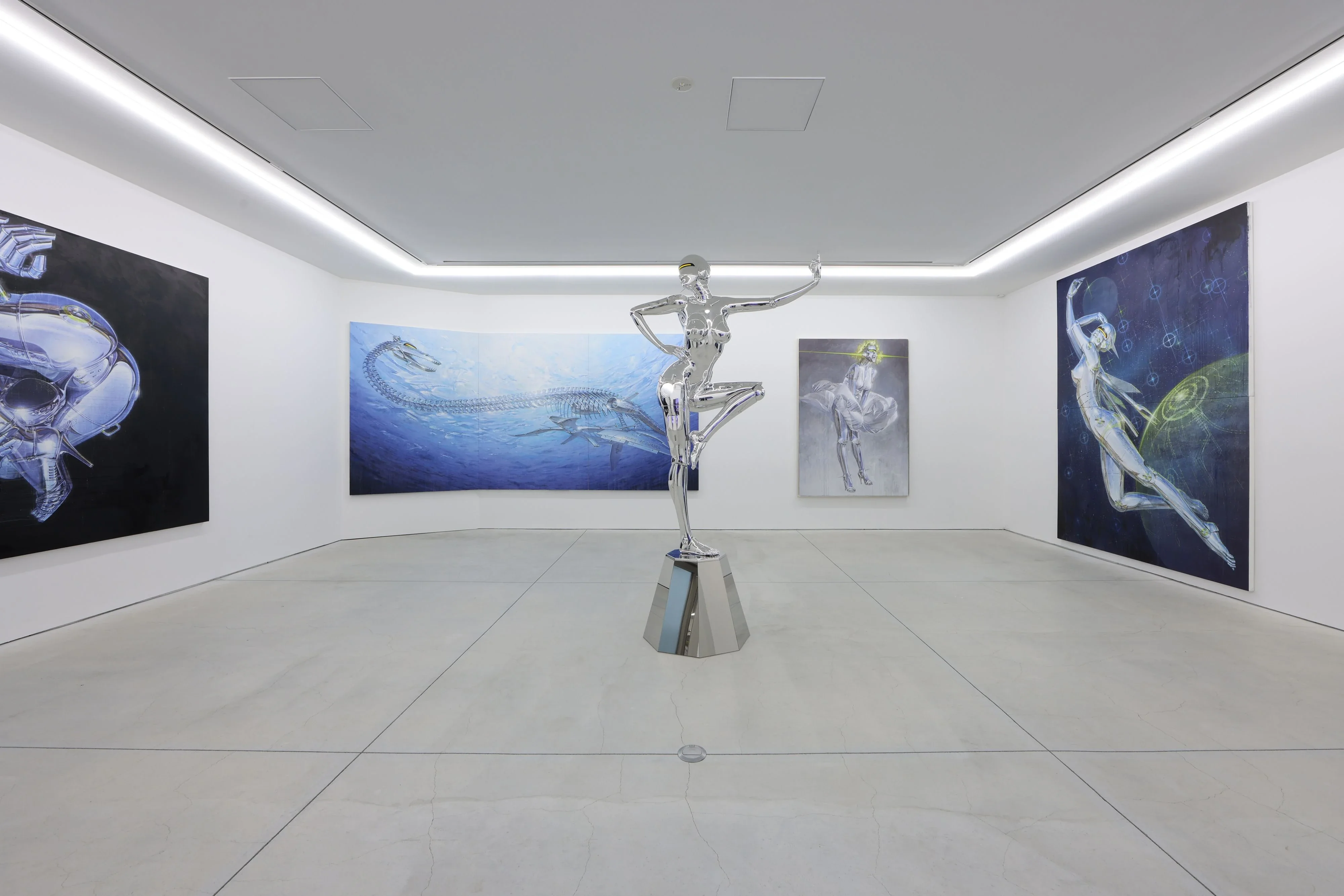
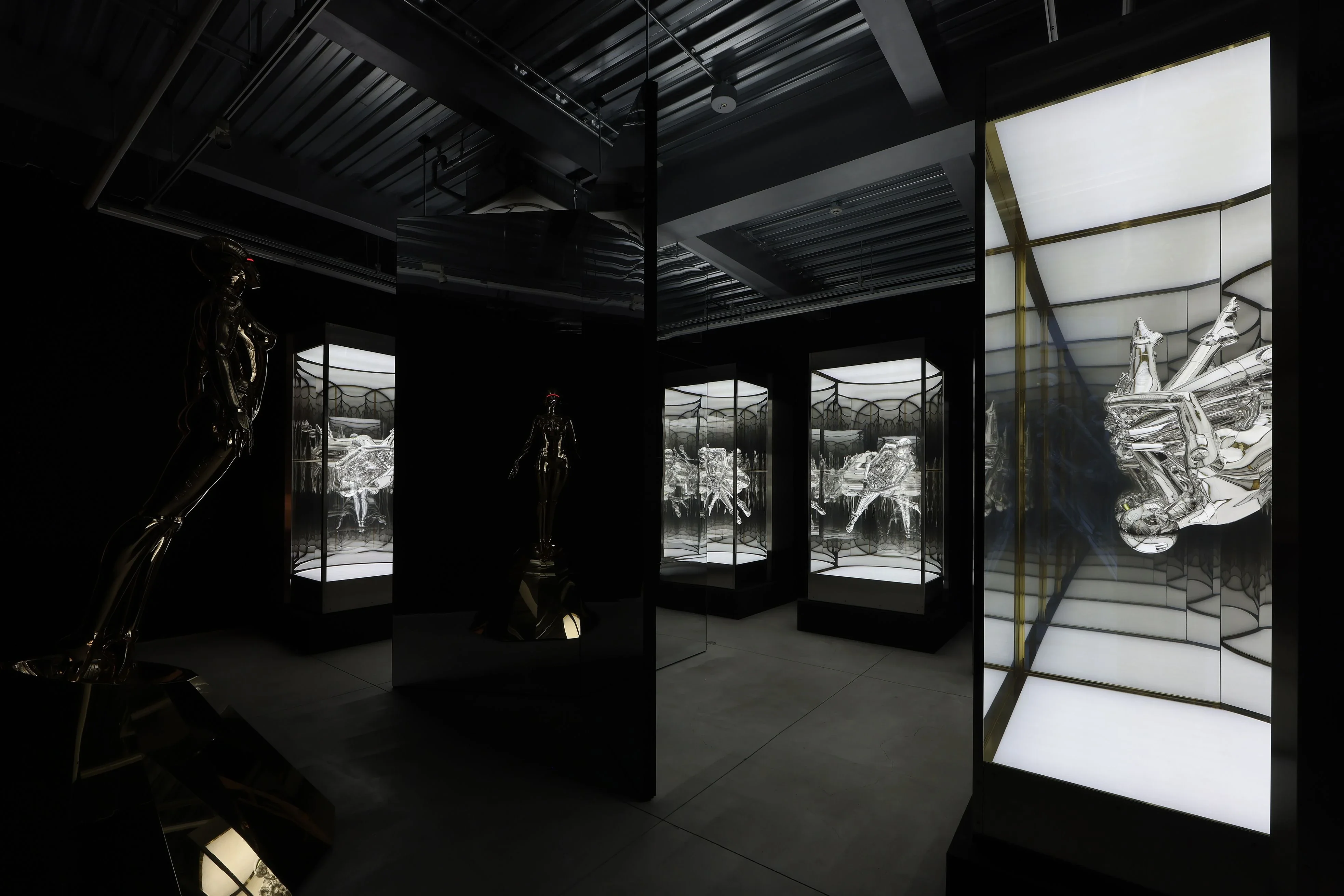
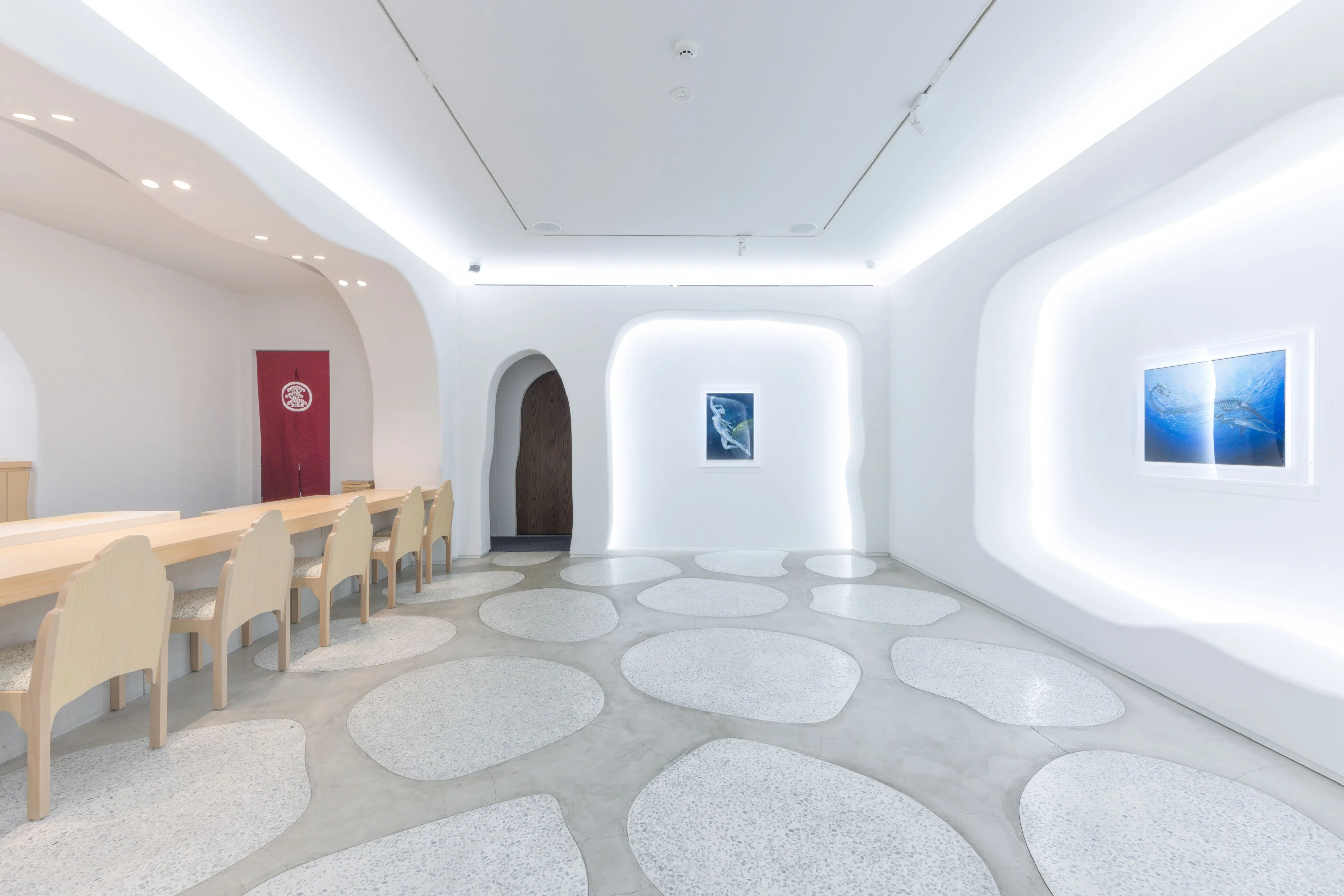
Installation photographs can help make those relationships visible. A canvas, a life-sized figure and a small object on a plinth show where scale changes and where a motif continues. They provide a sense of the distance between different parts of his practice, and of how those works inhabit a shared room.
Tokyo’s Space Traveler exhibition ran from 27 April to 28 May 2023 across NANZUKA UNDERGROUND, NANZUKA 2G and 3110NZ by LDH kitchen. Its photographs reveal different encounters with the work: a bright gallery, a dark reflective space and an interior where art shares its surroundings with a restaurant.
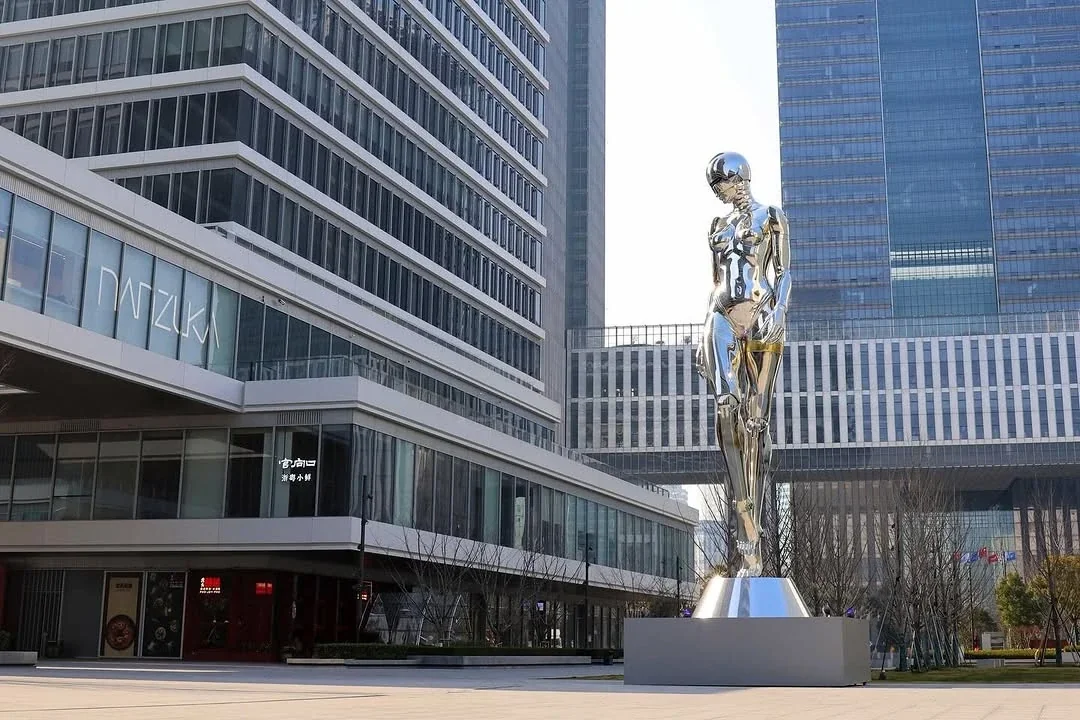
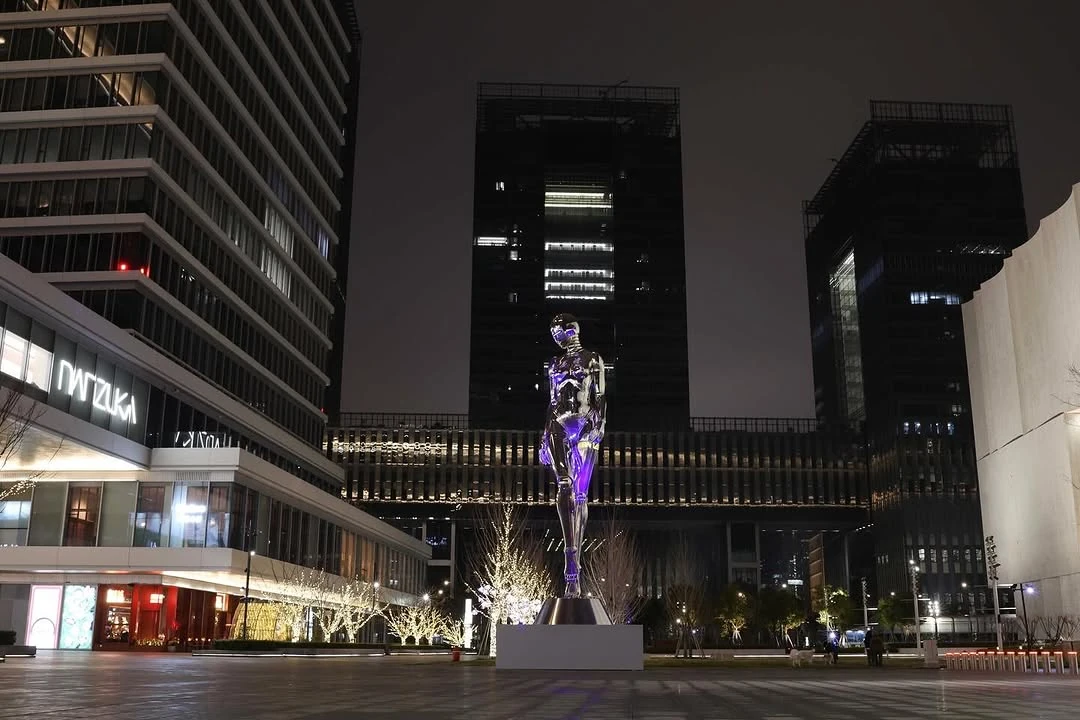
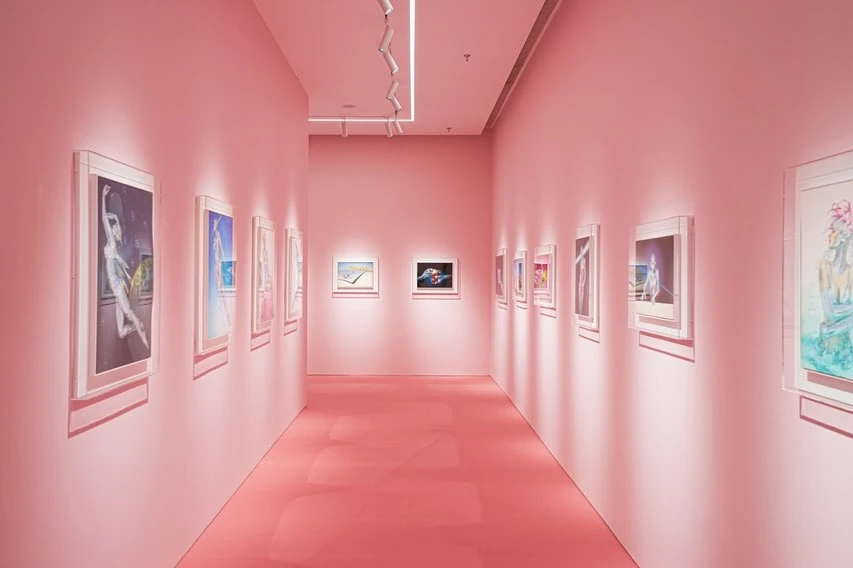
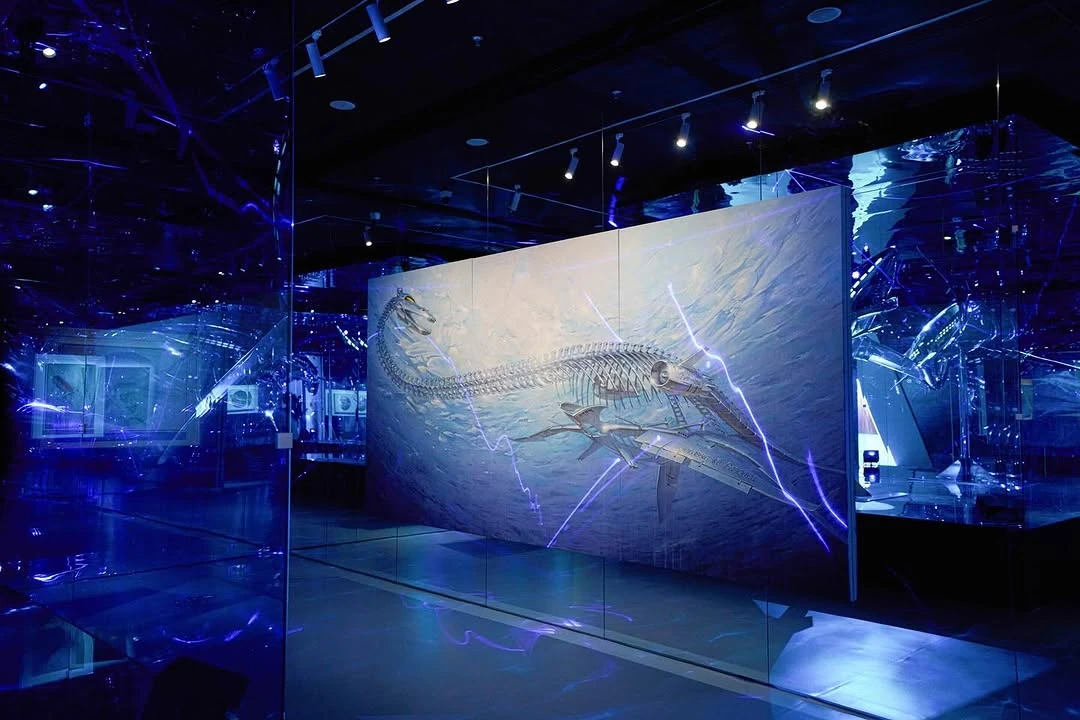
Photographs of Shanghai’s 2025 Light, Reflection, Transparency exhibition introduce another setting: galleries with coloured walls and a large robot outside at The Summit. Daytime and evening views show how the reflective figure changes with the city’s light.
Shanghai: daylight, evening and exhibition rooms
Space Traveler: different spaces
What gives a particular work its value?
Sorayama can be collected through original paintings, small-edition sculpture, editioned objects, books and collaborative products. Each format offers its own way of encountering the artist. A recognisable silver robot connects them without placing every object at the same price level.
For a large sculpture, the full title, year, material, edition and example number matter. For a smaller release, the manufacturer, completeness, any certificate issued with it and the condition of the finish help identify what is being offered. Technique and provenance are central to a painting. Sorayama’s name provides a connection while leaving these distinctions intact.
Public results at Christie’s and Phillips show that particular large works have achieved substantial prices. The examples are evidence about those objects, rather than a promise attached to every purchase. The work itself remains a good place to begin: the gesture, the changing surface and the scale that suits the room.
Advertising illustration, Sony’s museum-held robot, Dior’s stage and a sculpture in a collection become connected approaches to a difficult question: how can a cold-looking material create a sense of presence? Watching that transformation unfold can hold our attention long after the first brilliant reflection.
Explore smaller collectible releases in ArtComBuro’s Hajime Sorayama selection, where the artist’s wider story continues through objects for a personal collection.
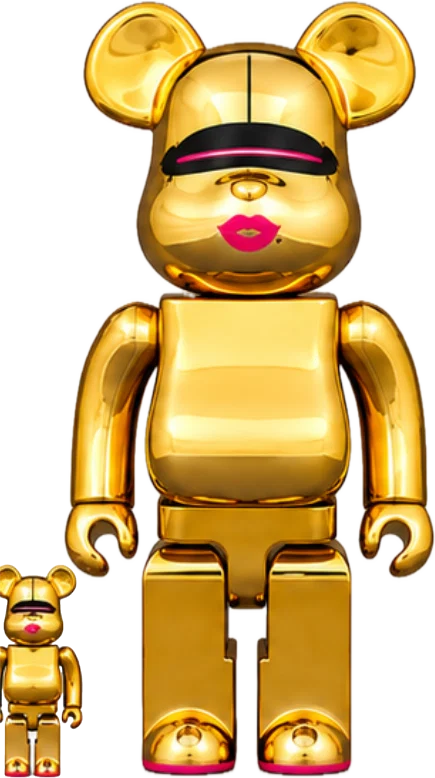
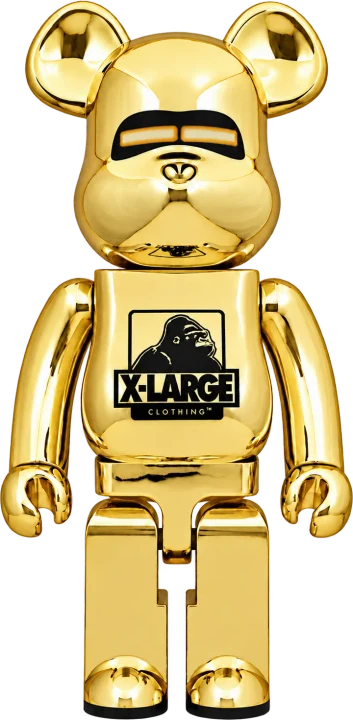
Explore the main releases and our selection in the BE@RBRICK × Sorayama guide.